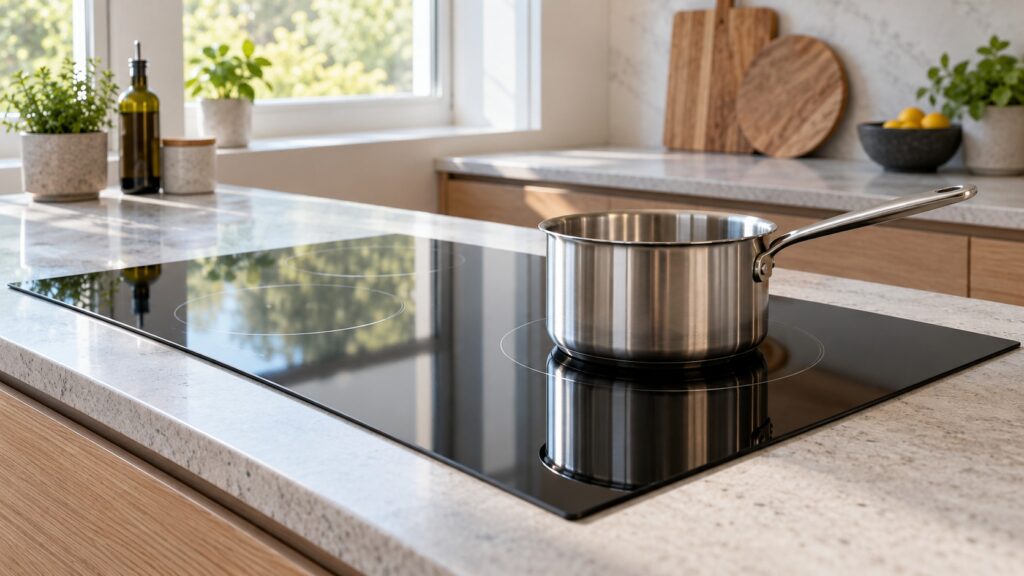
A La Cornue induction cooktop buzzing noise is not one of the error codes on our site, so we cannot point you to a code and say what it means. What we can say is how induction works and what to check. Induction heats the pan directly with a magnetic field, so the pan, its base and the power level all take part in what you hear, and the electronics under the glass are cooled as well. A hum or buzz can come from the cookware, the power setting or the cooling, and many such sounds are an ordinary trait of induction cooking. A noise that is new, loud, changing or paired with a flashing code or a burning smell deserves a diagnosis. This guide helps you sort the two and does not tell you to open anything.
Why does an induction cooktop make noise?
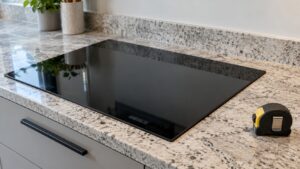
Our guide on how La Cornue induction cooking works explains that a coil beneath each zone carries alternating current and creates a rapidly changing magnetic field, which induces currents in the base of a magnetic pan, and the pan’s own resistance turns them into heat. Because the pan is part of the circuit, the pan can be part of the sound. In general, induction cooktops can hum or buzz depending on the cookware and the power setting, and a pan that is warped or light in construction is a common source. Our pages do not describe a buzz specifically, so treat this as general behavior of induction, not a La Cornue specification.
The cooktop also has electronics under the glass that generate heat. Our E2 guide says the system monitors its temperature and needs airflow to cool, and it mentions a cooling fan. A fan can be audible, so a soft whir is not the same as a buzz from the coil.
Is it the cookware?
Check this first, because it is free and it is the most common source. Our induction cookware guide says induction heats only magnetic cookware, that a flat, smooth base makes full contact with the glass, and that warped or ridged bottoms reduce contact and performance. Hold a magnet to the base; it should cling firmly. Center the pan over the zone and match its base roughly to the zone size. A pan that is much smaller than the zone is also a candidate for a flashing U, as our flashing U guide explains.
Try a different pan that you know heats well on another zone. If the sound changes or disappears, the noise belongs to the first pan, not the cooktop.
Does the power level change the sound?
Often. Induction zones run at a power level, and the control switches the coil on and off rapidly to hold lower levels, as our induction terms glossary describes. Our guide says the zones can boost for fast boiling. A sound that appears only at the highest setting and goes away when you turn the zone down is more likely related to the load or the cookware than to a failing part, though only a diagnosis can say for certain. Test it with the same pan at a lower level, then with a different pan, and note what you find.
Keep the glass clean and dry, and nothing resting on it. Our induction glass cleaning guide covers the surface. Do not place an object on a zone that may be hot; the H indicator shows residual heat, which our residual heat guide explains.
What should you write down before you call?
Note which zone makes the sound, which pan was on it, the power level, whether it happens only when a pan is present, and whether a code or a flashing symbol appears. Note whether the sound changes when you move the pan or turn another zone on. That information lets a technician tell cookware behavior from a cooktop fault much faster than a general description of a buzz.
Could it be something else in the kitchen?
Several sounds in a La Cornue kitchen are not the cooktop. A range with an oven may have a convection fan that makes noise of its own; see our convection fan noise guide. The range hood blower can vibrate; our hood pages cover rattling and weak suction. Cabinetry or a loose panel can resonate with a hum from the cooktop below. Switch each item off one at a time to find the source. If the cooktop sound is there with every zone off, it is probably not the coil.
When is the noise a reason to call?
Call if the noise is new and loud, if it changes or crackles, if a zone cuts out or flickers, if a code appears, or if it continues when no zone is in use. Our guides on E2 overheating and the U400 connection error explain two codes that can accompany induction problems. Miswired high-amperage supply can cause trouble from the start; see our induction wiring guide. We do not claim a buzz means a fault, and we do not claim it does not.
Do not lift the glass, open the cooktop or touch wiring. If you smell burning, see sparks or hear crackling, switch the zone off, and switch off the breaker at the panel while standing on a dry floor. We are an independent repair company, not the manufacturer. Our La Cornue cooktop repair page explains how a visit works, and you can schedule a visit online.