Best Cookware for La Cornue Induction
Best Cookware for La Cornue Induction is a common question among La Cornue owners. This guide walks through it step by step with technician-grade detail.
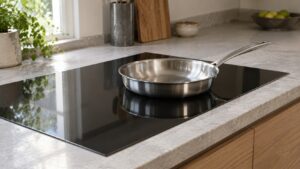
Induction is precise and responsive — but only with the right cookware. If a pan isn’t induction-compatible, a La Cornue induction zone simply won’t heat it (you’ll see a flashing “U”). This guide explains how to choose pans that perform.
The magnet test
Induction heats only ferrous (magnetic) cookware. The quickest check: hold a magnet to the bottom of a pan. If it clings firmly, the pan will work on induction. If it doesn’t stick (or only weakly), the pan won’t heat. For why, see our how induction works guide.
Materials that work
- Cast iron (including enameled cast iron) — excellent, strongly magnetic.
- Carbon steel — great for high-heat searing.
- Magnetic stainless steel — many quality stainless pans have a magnetic base layer; check with a magnet.
- Induction-rated multi-clad cookware — look for an induction symbol or magnetic base.
Materials that don’t work (alone)
- Aluminum, copper, and glass — not magnetic, won’t heat unless they have a bonded magnetic base.
- Non-magnetic stainless — some stainless grades aren’t magnetic.
Flat bottoms matter
A flat, smooth base makes full contact with the glass for efficient, even heating. Warped or ridged bottoms reduce contact and performance. Avoid dragging rough-bottomed pans, which scratch the glass — see our induction glass cleaning guide.
Size and centering
Match the pan base roughly to the zone size and center it over the coil. A base much smaller than the zone may not be detected (triggering a flashing “U”) or may heat inefficiently — see our “U” flashing guide.
Tips for best results
- Lift pans rather than sliding them to protect the glass.
- Use heavier pans for steadier heat retention.
- Don’t leave high-heat pans to boil dry — this can trigger an E2 overheat.
Learn more
Induction specifications are on lacornueusa.com. If a known-good pan won’t heat on a zone, the coil or sensor may be responsible — schedule a diagnostic.
Building an induction-ready set
You do not need to replace everything at once. Prioritize the pans you reach for most — a skillet, a saucepan, a stockpot — and confirm each with the magnet test before buying more. Enameled cast iron and carbon steel are reliably magnetic; quality multi-clad stainless often has a magnetic base layer but should still be checked, since some stainless grades are non-magnetic. Aluminum, copper, and glass will not work unless they have a bonded magnetic base.
Care that protects both pan and glass
Flat-bottomed cookware makes full contact for efficient, even heating, while warped or ridged bottoms reduce performance and can rock. Match the pan base roughly to the zone size and center it over the coil — a base much smaller than the zone may not be detected, showing a flashing “U”. Lift pans rather than sliding them, which protects the ceramic glass from scratches; see our induction glass cleaning guide.
Frequently asked
- Why won’t my pan heat? Most often it is not magnetic, too small, or off-center — see our “U” flashing guide.
- Will heavy pans help? Yes — heavier, flat pans hold heat more steadily and sit flush to the glass.
The magnet test and what works
The quickest check is a fridge magnet: if it clings firmly to a pan’s base, the pan will heat on induction; if it does not grip, it won’t. Cast iron and enameled cast iron, carbon steel, and magnetic stainless all work well, while aluminum, copper, glass, and non-magnetic stainless will not heat unless they have a bonded magnetic base. Beyond material, a flat bottom makes full contact for efficient, even heating, and matching the pan base to the zone size and centering it over the coil prevents the flashing “U” of a pan that isn’t detected. Build your set around the pans you reach for most.