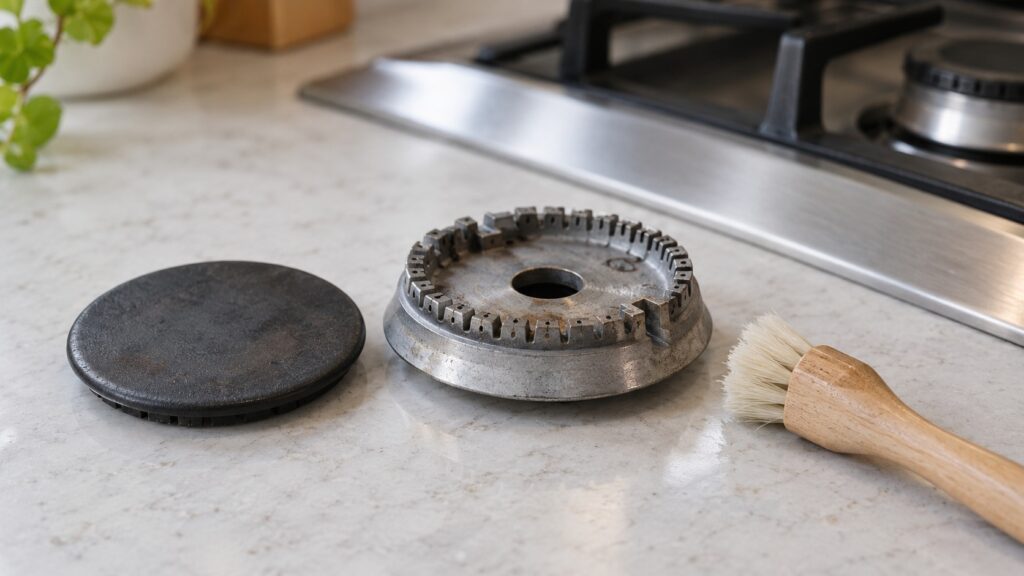
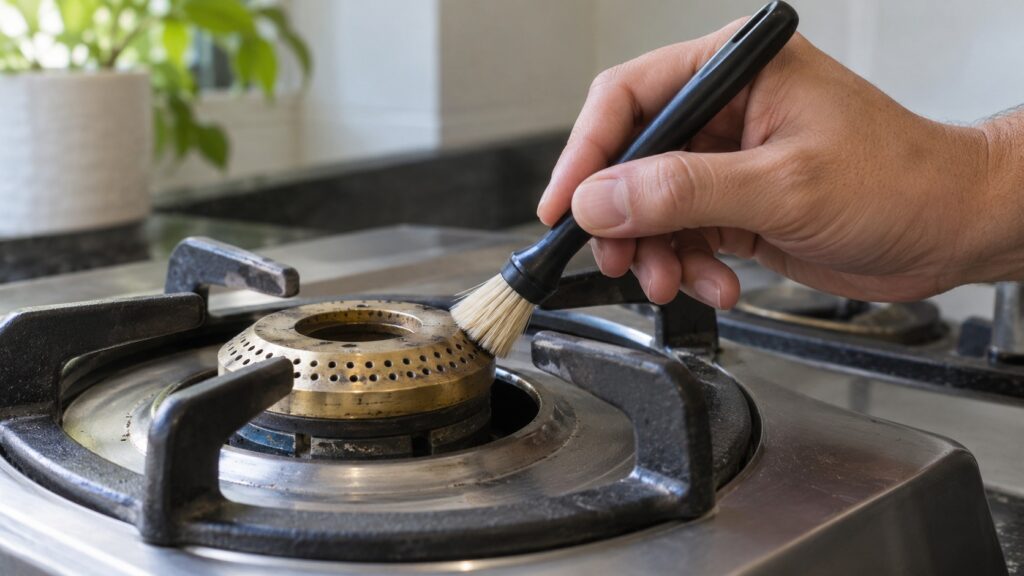
To clean La Cornue burner ports, make sure every knob is off and the burner is completely cold, lift the grate and the cap, clear each port with a wooden toothpick and brush the burner head gently with a soft brush, then dry it all completely before the cap goes back on flat. Our care guide is clear that ports are cleared with a wooden toothpick, working from the outside in, and never with a drill bit, a pin or a paper clip, because metal enlarges a port permanently and changes the flame at that point for good. The ignition electrode needs only to be kept clean and dry. Gas parts are not owner repairs, so stop at cleaning.
How do you clean the ports on a La Cornue burner?
Wait until the burner has cooled completely; cast iron holds heat long after the flame is off. Lift the grates first, then the caps and crowns, noting which cap came from which burner, because they are not always interchangeable and a cap on the wrong crown sits proud. Soak the removable parts in hot water with a little dish soap to loosen the soil. Then clear each port with a wooden toothpick, working from the outside in, and brush the head with a soft brush or a nylon pad. We do not set a soaking time, because it depends on how much has built up. Rinse, then dry thoroughly with a towel and let the parts air-dry completely before they go back. Our burner caps and grates care guide has the full routine.
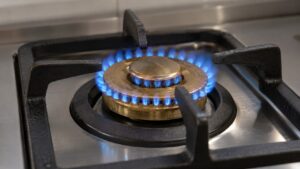
A port blocked by a boil-over leaves a gap in the flame ring and a weak or uneven flame. After you clear it, the ring should look even all the way around.
What is the ignition electrode, and how do you keep it clean?
The electrode is the small part near the burner that sparks when you turn the knob to light. It is the thing that clicks. It works by jumping a spark across a gap, so it must be clean, dry and in the position it was fitted in. Our care guide explains that a wet electrode makes the spark track across the moisture instead of jumping the gap, and that a cap seated a few degrees out of true moves the flame path away from the spark. When you clean, wipe around the electrode with a dry soft cloth and do not spray cleaner at it. Do not bend it, scrape it or try to pull it out. If it is cracked, loose or very dirty with baked-on residue you cannot lift, tell a technician rather than prying at it.
What should you never use on the ports?
Never a drill bit, a pin, a needle, a paper clip or anything metal; the wooden toothpick is the tool, and only on a cold burner with the cap off. Do not use steel wool, scouring powder or acid cleaners on brass or enameled parts, and never run the parts through the dishwasher, where the detergent and the heated dry bake the damage in. Do not use oven cleaner on burner parts. If a port looks enlarged or damaged, the flame there will look different from its neighbors forever, and the cap or crown may need replacing, as our care guide explains. A burner that has been damaged this way is a technician’s call. Do not try to adjust the gas or the air flow yourself.
How do you put the burner back together?
Set the crown on its seat, then the cap flat and centered on it, and finish with the grate. A cap resting on a crumb, or a few degrees out of true, is the most common cause of ignition complaints after a clean. Give the surface a final wipe, then use the burner the way your owner’s manual describes and look at the flame: it should be steady, blue and even around the ring. If a burner does not light, do not force it; see the checks below. If you smell gas at any point, do not light anything or touch any switch; leave the home and call the gas utility or 911 from outside, as our gas smell safety steps explain.
What if the burner still will not light after cleaning?
That is common in the day or two after a deep clean, and the usual cause is moisture or a misplaced cap. Lift each cap, dry it and the electrode area, and set the cap back squarely. If a burner still clicks without lighting, our clicking igniter guide and the range won’t light checklist go through the rest of the sequence. If a burner has begun to burn yellow, see the yellow flame guide. If none of that helps, the igniter, a valve or the spark module may need service, and that belongs to a technician.
How often should you clean the ports?
Often enough that debris never builds up. Our care guide suggests a weekly clean is enough for most kitchens and says to do it the same day after anything boils over, because a sugar or brine spill left on a cap is a corrosion site by the end of the week. We do not set a schedule beyond that. If you cook a lot of sauces and stocks, check the ports more often. A quick look at the flame ring each time you cook tells you when something is blocked.
What about brass and enamel burner parts?
The caps are brass or enameled metal, and neither forgives being left wet, run through a dishwasher or scrubbed with the wrong abrasive. Heat discoloration on brass is normal wear, not damage, and polishing it away thins the finish. Salt, acid and standing moisture are what corrode them, so wipe up boil-overs the same day. If a cap has chipped through the enamel to the metal, or a rim has been eaten away, it is a replaceable part and a technician can fit the right one. Our brass cleaning and polishing guide explains how to care for the brass without harming it.