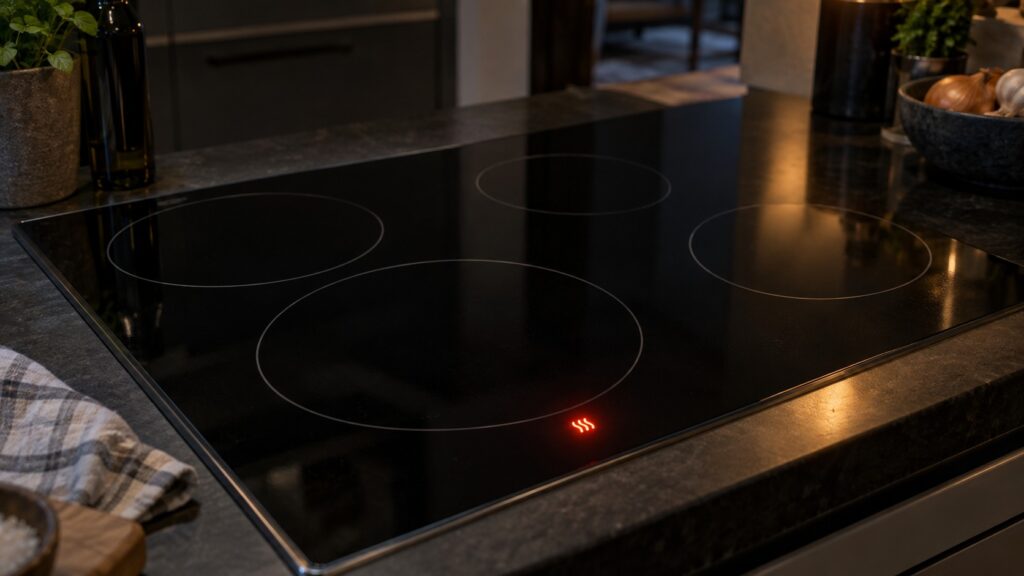
The la cornue residual heat indicator is the letter H that appears over an induction zone after cooking, and it is a warning rather than an error: it means the glass above that zone is still hot enough to burn, even though the zone itself has been switched off. On our code pages it is listed as low severity and owner-serviceable for exactly that reason. It is the one symbol on a La Cornue induction top that requires nothing from you except caution — unless it refuses to go out, which is a different conversation.
What does the H on a La Cornue induction cooktop mean?
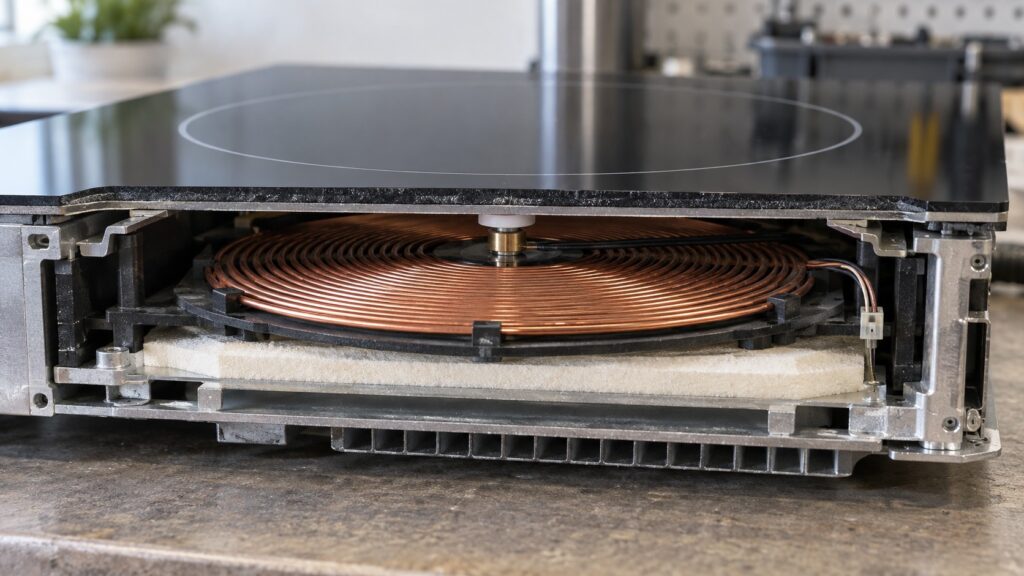
Induction heats the pan, not the glass. The coil under the surface creates a magnetic field, the field induces currents in the base of a ferrous pan, and the pan’s own resistance turns those currents into heat. The glass gets hot second-hand, from the pan sitting on it, and it holds that heat after the zone stops drawing power.
The H indicator exists because that heat is invisible. On a gas burner you can see the flame go out; on a radiant electric element you can often see the glow fade. On induction there is nothing to see at all, and the surface can be hot enough to blister a hand for several minutes after a pan has been lifted off. So the control keeps a sensor reading on each zone and prints H over any zone still above a safe touch temperature. If you want the underlying physics rather than the indicator, our guide to how La Cornue induction cooking works covers it.
How long does the residual heat indicator stay on?
As long as the glass is hot, which depends entirely on what was cooking. A quick boil in a thin pan leaves little heat behind and H may clear in a minute or two. A heavy cast iron pan held at a high setting for an hour can keep a zone hot for fifteen minutes or more after it comes off.
Two things surprise owners. The first is that H can appear on a zone you never turned on, because a large pan overhanging its zone warms the glass next door. The second is that H can come back after clearing if you set a hot pan down on a cooled zone. Neither is a malfunction; both are the sensor doing its job.
Is it safe to clean the surface while H is showing?
No, and this is the practical reason the indicator matters. A cleaning cloth on glass that is still above boiling point will steam and can scald, and a cream cleaner applied to a hot surface bakes on instead of lifting off — which leaves a film that is far harder to remove than what you were cleaning in the first place.
Wait for the H to clear, then clean. The exception is a sugar spill: molten sugar and anything containing it must be scraped off while the glass is still warm, because when it cools it bonds to the surface and can pit it. Scrape from the edge with the plastic scraper supplied for the job, never a metal blade, and keep your hand clear of the hot area. Our page on cleaning La Cornue induction glass sets out the routine and the products to avoid.
How is H different from U, E2 and U400?
H is the only one of the four that reports a normal condition. The other three all describe something the cooktop cannot do.
A flashing U means pan detection has failed on that zone: the cookware is not magnetic, is too small for the zone, or has a base warped enough that the field cannot couple to it. E2 is an overheating condition, typically from a pan boiled dry or from ventilation blocked beneath the top. U400 is a communication fault between the control and the induction generator, and on a newly installed range it is far more often the electrical supply than a failed board. Our pages on the flashing U and on E2 overheating take each apart.
Keeping them straight matters because the responses are opposite. H asks you to wait. U asks you to change the pan. E2 asks you to stop cooking on that zone and find out why it is running hot. U400 asks for a technician who can check the supply before anyone orders a part.
When is the residual heat indicator actually a fault?
When it does not behave like heat. Three patterns are worth acting on:
- H that never clears. If a zone still shows H an hour after cooking, and the glass is genuinely cool to a careful touch at the edge of the zone, the zone sensor is reading high. The indicator is wrong, not the glass.
- H that never appears. A zone that has just boiled a pan of water and shows nothing at all is the more dangerous failure, because it removes a safety warning you have learned to trust. Check it against another zone after the same cooking.
- H on a cold cooktop at power-up. A zone showing residual heat the moment the top is switched on in a cold kitchen is reporting a sensor or wiring problem, not a temperature.
All three are sensor-circuit questions, and the sensor sits under the glass with the coil. That is not an owner-accessible area: lifting an induction top means disturbing the sealed glass assembly and the generator wiring beneath it. Before booking, cut power at the breaker for two minutes and switch the top back on — a latched reading will often clear, and a reading that returns immediately confirms the fault is live.
What should you do if a zone stops trusting its own sensor?
Treat the surface as hot until proven otherwise, keep the zone out of use if the indicator is unreliable in either direction, and book a diagnostic visit. A sensor that misreads residual heat today is often the same circuit that later refuses to hold a power level, so it is worth catching while the cooktop is still usable.
We are an independent repair company working on La Cornue induction equipment in all 50 states, not a factory service arm, and we will tell you when a repair is not worth doing. Pricing starts from a diagnostic visit, from $149 in most areas, and we confirm the estimate before any work begins. Call 1-844-579-1439 with the zone position and what the indicator does, use our La Cornue cooktop repair service, or schedule a visit online.