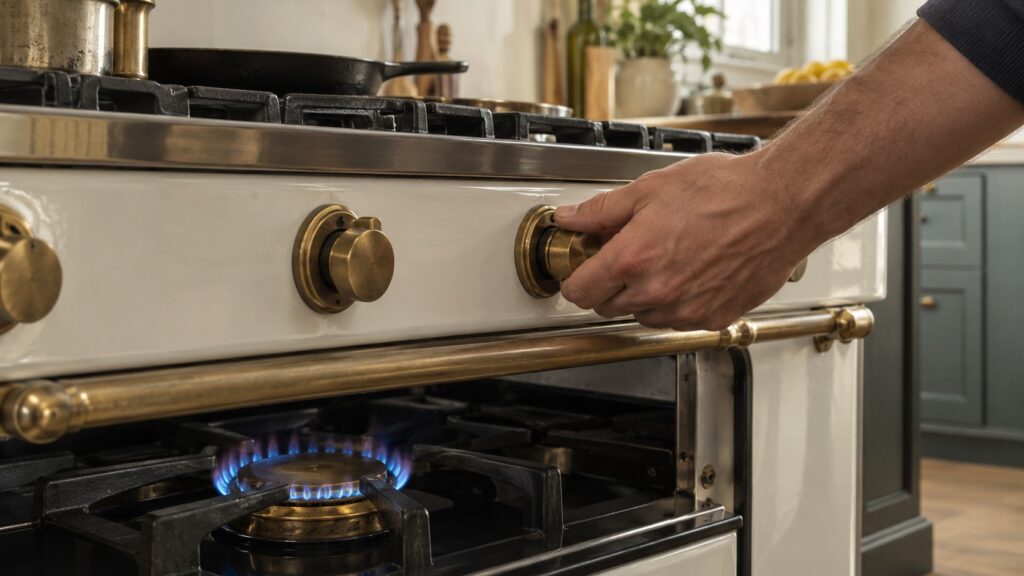
How to use La Cornue range controls starts with knowing which kind of range you have, because the parts that turn on are different. A gas burner has a knob with a light or ignite position and a clicking spark. A gas vaulted oven starts a glow-bar igniter when you set a temperature. An electric or convection oven has a mode and a temperature. An induction zone needs a magnetic pan and shows an H when the glass is still hot. This guide covers the general steps for each. For exact knob positions, preheating and oven modes on your model, follow the manufacturer’s instructions and your owner’s manual; we do not publish a lighting sequence for any model here.
What should you do before you turn a new La Cornue on?
Confirm the range is fully installed: leveled, secured against tipping, and with the gas and electrical connections made by licensed professionals and leak-tested. Remove all packaging, tape and protective films from inside and out. A brand-new range carries oils and coatings that burn off during first use, so follow the break-in steps in our first-use break-in guide: run the empty oven at high temperature for the period recommended for your model, light each burner to confirm a steady blue flame, season the French Top, and keep the kitchen ventilated with the hood running. Some smell and light haze is normal during break-in. Persistent smoke or any gas odor is not.
The spark ignition and the electronics need electricity even on a gas range, so a gas range will not light if its power is off. Check that the range has power before you assume the burner is broken.
How do you turn on and use a La Cornue gas burner?
La Cornue gas ranges use brass burners with mechanical knobs. According to our won’t-light checklist, the knob is turned to the light or ignite position while you listen for clicking. Then look for a steady blue flame. Keep these habits:
- Make sure the burner cap sits flat and the grate is placed correctly, because a tilted cap can stop the spark reaching the gas.
- Dry the burner after cleaning. Moisture under the cap can make a burner spark erratically or refuse to light after cleaning, which is a common false alarm.
- For a low simmer, use a heavy-based pan and crack the lid. A flame that goes out under a tight lid is usually short of air, not short of burner, per our simmer and low heat tips.
- If a burner clicks and will not light, see clicking igniter fix. Do not hold a match or lighter to it.
The exact knob positions and any safety lockout differ by model, so follow your manual. If you ever smell gas, stop: do not light anything and do not switch any electrical item on or off, including lights, the hood and your phone while inside. Leave the home and call the gas utility or 911 from outside, and do not go back in until professionals say it is safe. Our gas smell safety steps explain what to do and what not to try.
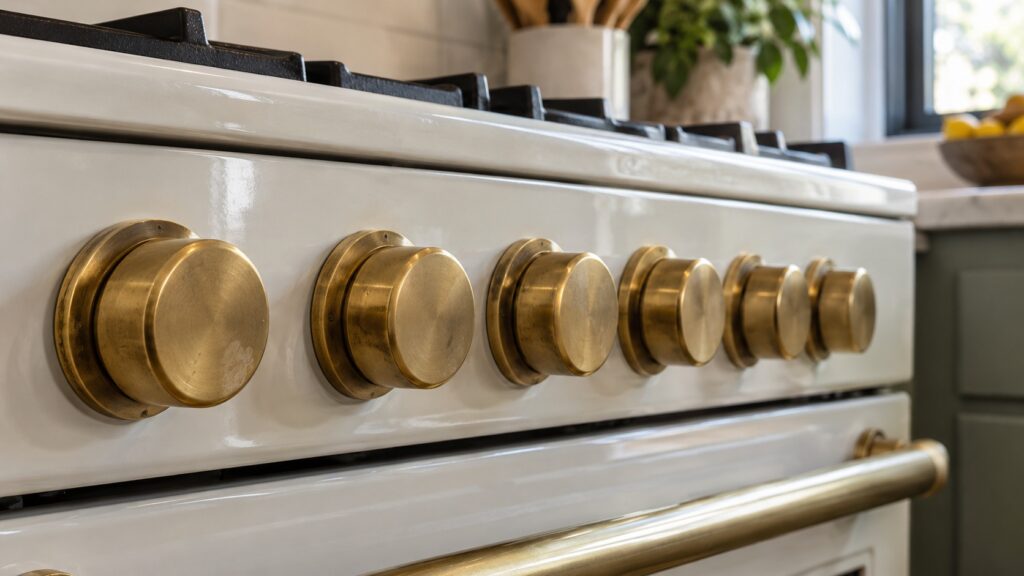
How do you turn on and use the oven?
It depends on the oven. On a Château, the vaulted oven (the voûte) is a sealed dome with no window that radiates heat around the food. In the gas version, setting a temperature starts a glow-bar igniter; the igniter has to draw enough current to open the gas safety valve before gas flows and lights, per our gas oven igniter guide. The electric vaulted oven is steadier and is paired with a gas one on the 120 and larger sizes. Read how the vaulted oven works to understand the cooking character; it browns and roasts gently without the drying air of a strong fan.
The CornuFé 90 Albertine uses a multifunction convection oven with seven modes. Our CornuFé seven oven modes page lists typical functions: conventional bake, convection bake, convection roast, bottom heat, top heat or browning, broil and a gentle defrost or warm mode. Exact mode names and symbols are in your manual. Never use water on a grease fire: cover the pan with a lid, turn off the heat and do not run the hood.
How do you use induction and the French Top?
Induction zones heat only magnetic cookware. Hold a magnet to the bottom of a pan; if it clings firmly, the pan will work, as in our best cookware for La Cornue induction guide. The zones are listed at 2,100 watts each, or 3,700 watts with boost, and a pan detector and a residual-heat H indicator are built in. A flashing U means the zone cannot see suitable cookware. The H means the zone is off but the glass is still hot; our residual heat indicator page says it clears by itself. Do not touch the glass while H is showing.
The French Top, the cast-iron plate with the signature stars, works differently: you cook by position rather than by knob. The center is hottest, the middle holds a steady simmer and the rim keeps food warm. See how to cook on a French Top, and season the plate before first use as described in how to season a French Top.
What if something does not turn on or behave?
Check the basics: power to the range, the gas supply valve open, the burner cap seated and dry, and the correct pan for the zone. A burner that will not light after cleaning, an oven that stays cold or an induction zone that shows a code should be looked at by a technician; gas valves, igniters and induction wiring are not home repairs. Read La Cornue range repair to see how a visit works.