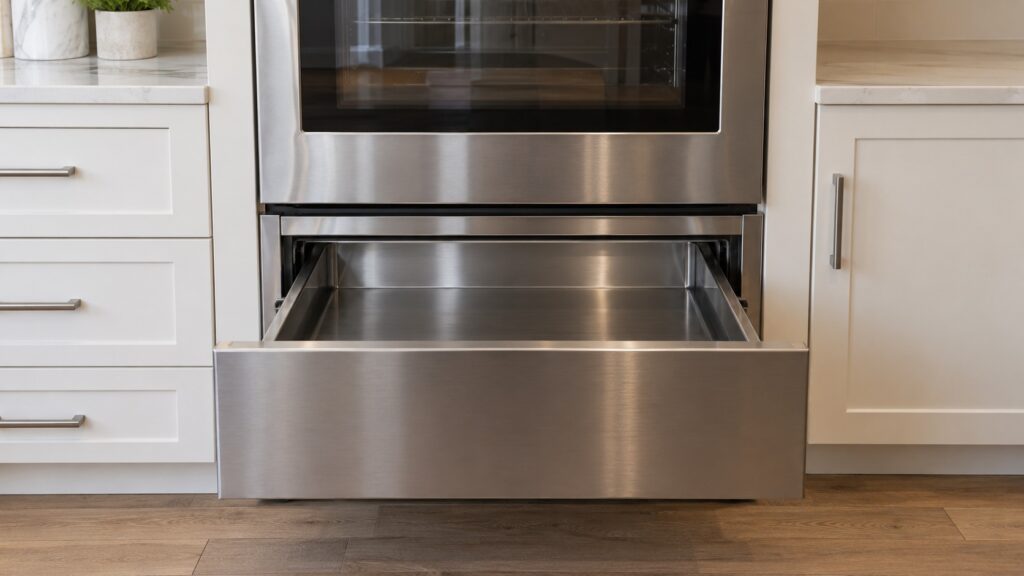
A La Cornue warming drawer not heating is most often one of four things: the drawer is not fully closed, the setting is too low or the vent is open, the drawer is simply warming slowly because it is a gentle appliance, or the thermostat or element has failed. Check the closing, the setting and a thermometer reading first. If the drawer is truly cold after an hour with the power on, the cause is electrical, and it needs a technician.
How warm should a La Cornue warming drawer get?
Much less hot than an oven. A warming drawer holds food at a serving temperature, using a low-output element and a thermostat in an insulated drawer, and it warms slowly. After you switch it on, expect the drawer to feel warm in fifteen to thirty minutes and to reach its holding temperature in perhaps thirty to sixty, depending on the setting and whether the drawer is empty. The thermostat cycles the element, so the drawer is not heating continuously, and a drawer that feels only warm is usually working as designed. Our guide on how La Cornue warming drawers work explains the mechanism and the setting you should expect.
Before you decide anything is wrong, give the drawer a full hour with a few dishes inside. An empty drawer on a low setting may feel barely warm to the hand.
Is the drawer closed all the way?
This is the most common cause and the easiest to check. A warming drawer will not heat properly if it is open even slightly, because the warmth escapes and, on some models, a safety switch stops the element when the drawer is not fully closed. Push the drawer shut firmly and see whether it sits flush with its neighbors. If it will not close fully, or it sits crooked, the runners or the alignment may be off. Our guide to a warming drawer that is misaligned and will not close shows what to check, and the problem may be down to installation, which our guide on faults that are really installation problems covers.
Are the setting and the vent right?
The lowest settings on a warming drawer are intended for proving dough and warming plates, not for holding a casserole through an evening, so the drawer may feel cool at the lowest setting even when it is working. Raise the setting to a low-to-middle level, and check the vent. An open vent lets heat and moisture out, which can make the drawer feel cooler, while a closed vent holds both in. If you are holding food that needs to stay moist, close it. If you are holding bread or pastry, open it. Our guide on how the drawers work explains the vent and the setting together.
Is the drawer getting power?
Check the household supply before suspecting the drawer. Look at the circuit breaker for the kitchen, and reset it if it has tripped. Check whether the drawer has a power switch or a control that must be on, and whether any indicator light comes on when it should. If there is no light and no warmth, the drawer may not be receiving power. A tripped breaker that returns immediately is a sign of an electrical fault, and you should leave the drawer off and call a technician. Do not open the drawer housing or touch the wiring.
What if it is only partly warm or warm in one place?
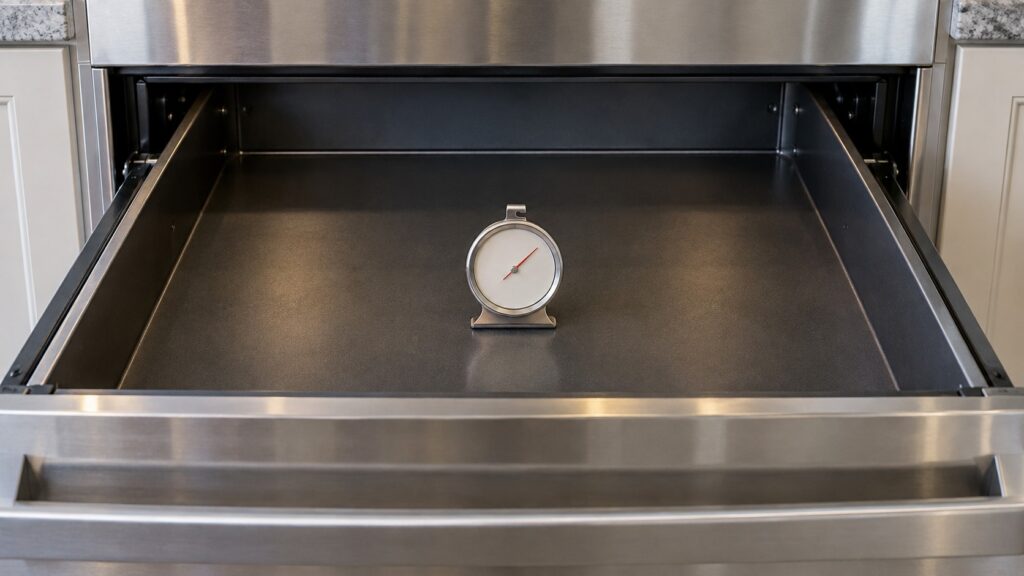
An uneven drawer, with warmth at one side and cool at the other, suggests a thermostat or element problem. A thermostat that has drifted can switch off early, so the drawer never reaches its target. A partly failed element can give heat in one area only. You can test the drawer with a probe thermometer: set it to a middle setting, put an oven-safe thermometer in the middle of the drawer, close it and check after an hour. Our guide on thermostat replacement and calibration explains how a thermostat is checked and recalibrated.
The reading is the useful part. If it sits well below what the setting should give, the drawer is not holding food safely, and you should stop using it for that purpose until it is repaired.
What does food safety require?
Hot food must stay above 140 degrees F to be held safely. A drawer that is not heating properly does not meet that standard, and food left in it can spend too long in the temperature range where bacteria multiply. Do not hold food for more than a short time in a drawer you are not sure about, and reheat in the oven or on the cooktop instead. A warming drawer is for keeping hot food hot, not for heating cold food.
When should you call a technician?
Call if the drawer is closed, powered and on a sensible setting, and it is still cold after an hour. Call if a breaker trips, if you smell something hot or if the drawer has an indicator that never lights. The element and the thermostat are the most likely parts, and both are replaceable at a modest fraction of the cost of the appliance. See our guide to where to source La Cornue parts and service if you want to understand the route for parts, and book a visit when you are ready.