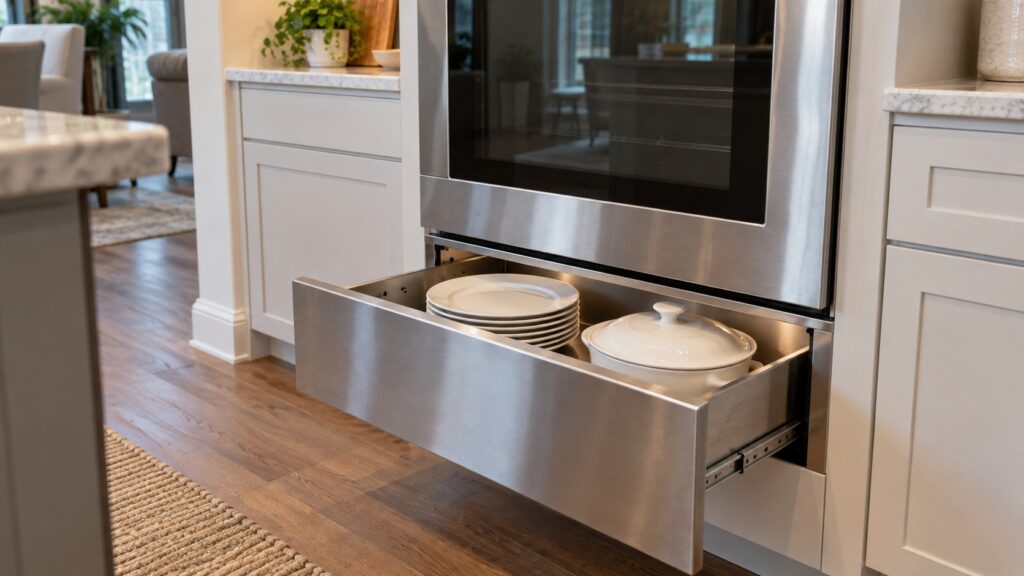
La Cornue warming drawers do one job that no other appliance in the kitchen does well: they hold finished food at a serving temperature without continuing to cook it. That sounds trivial until you have tried to keep three dishes hot for a table of ten. The mechanism is simple — a low-wattage element, a thermostat and a well-insulated drawer — and understanding it explains both what they are excellent at and where people are disappointed.
How the heat is delivered
A warming drawer heats gently and evenly rather than intensely. The element runs at a small fraction of an oven’s output, and the drawer’s insulation does most of the work of holding temperature once it is up. That combination is why food can sit for an hour without drying to leather: the air inside is warm and still rather than hot and moving.
The thermostat cycles the element to hold a set point, so the drawer is not continuously heating. You will hear or feel nothing while it works, which is one reason people occasionally think it has failed when it is simply between cycles.
The vent is the control people never use
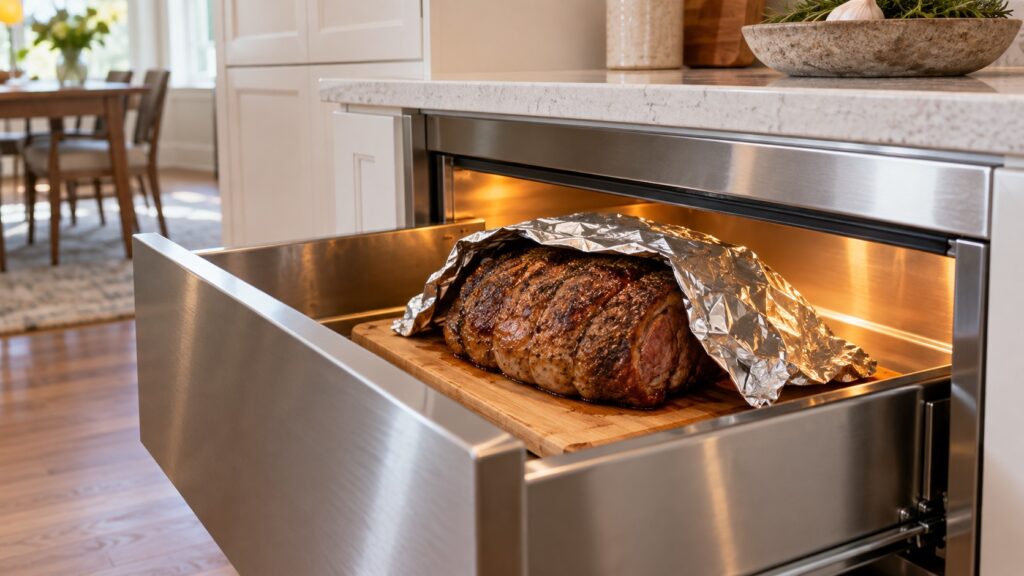
Most warming drawers have a humidity vent — open or closed, sometimes several positions. Closed, the drawer holds the moisture the food gives off, which keeps roast meat succulent and stops a casserole developing a skin. Open, that moisture escapes, which is what bread, pastry and anything with a crust need.
Using the wrong setting produces the two complaints we hear: soggy bread, and a joint of meat that has dried at the edges. It is a single lever and it makes more difference than the temperature dial.
What it is genuinely good at
- Resting meat. A roast needs to rest, and resting it on a counter loses temperature you then cannot get back without overcooking. A closed drawer at a low setting holds it exactly where you want it.
- Warming plates. Food served onto a cold plate loses several degrees immediately. This is the single most noticeable improvement a warming drawer makes to an ordinary dinner.
- Staggered dishes. When one element of a meal finishes twenty minutes before the rest, the drawer is the difference between serving everything hot and reheating something badly.
- Proving dough. At its lowest setting, with the vent closed, it is a reliable proving box — better than an oven with the light on.
What it is not
It will not reheat food from cold in any reasonable time, and trying is where food safety gets uncomfortable: a large cold dish spends too long in the temperature range where bacteria multiply. Reheat in the oven or on the cooktop, then hold in the drawer.
It will also not crisp anything. A drawer will keep fries hot and will not keep them crisp, whatever the vent setting. And it is not a second oven — the element has neither the output nor the temperature range, and asking it to behave like one is the fastest route to disappointment.
Where it sits, and why that matters
A warming drawer is usually built into a cabinet run or beneath a wall oven, and like every built-in appliance it needs its specified clearances to shed the small amount of heat it does produce. Boxed in tightly, it runs its element longer to hold the same temperature and the cabinet above gets warm.
The other siting question is reach. A drawer at floor level is awkward to load with a full roasting pan, and a drawer above waist height is awkward to lift a heavy dish out of. Somewhere between the two is where it actually gets used. Our guide on faults that are really installation problems covers what happens when clearances are ignored.
Temperature, and the number that matters for safety
Holding food safely is a specific requirement, not a vague one: hot food needs to stay above 140°F, and a warming drawer set too low is a bacterial incubator rather than a holding cabinet. The lowest settings on these drawers are intended for proving dough and for warming plates, not for holding a casserole through a long evening.
The practical rule is to use a low-to-middle setting for food and reserve the lowest for empty-drawer jobs. If you are holding anything for more than an hour, put a probe thermometer into the thickest part of the dish once and confirm where your drawer actually sits at that setting. Dials drift, and a drawer that held food safely five years ago may not today.
What goes wrong
There is very little to fail. The element, the thermostat, the control and the drawer runners are the whole list. A drawer that does not warm at all is usually the element or its control; a drawer that gets too hot is a thermostat that has lost calibration, and that one is worth attending to because it turns a holding appliance into a slow cooker.
The runners are the most common complaint and the least serious: a drawer loaded heavily for years begins to drag or sit unevenly, and that is an adjustment or a runner replacement rather than an appliance problem.
Using it well, and when to call
Preheat it. An empty cold drawer takes time to come up, and food put into it in the meantime cools rather than holds. Load it with the food already at temperature. Choose the vent setting for the food, not out of habit. And do not stack dishes so tightly that the warm air cannot move between them.
We are an independent repair company, not a factory service arm. Pricing starts from a diagnostic visit and we confirm the estimate before any work begins. La Cornue oven and warming drawer repair covers elements, thermostats and controls, and you can schedule a visit online. If the drawer sits under a range, our calibration guide is worth reading as well.