
A surprising share of La Cornue service calls are not appliance faults at all. They are installation problems presenting as appliance faults, and they share a family resemblance: the range worked at first, or worked on some functions and never on others, or has behaved oddly since the day it arrived. Recognizing la cornue installation problems for what they are saves a diagnostic visit and, more often, saves you from replacing a part that was never broken.
Gas type is the biggest single cause
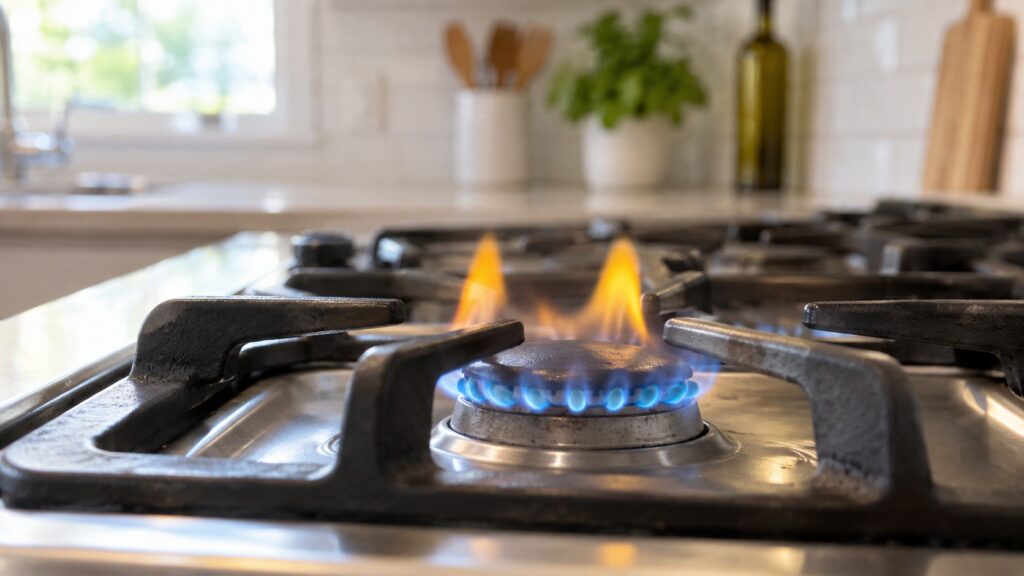
A La Cornue range is built for one gas and converted to the other with an orifice kit and a qualified technician. It is not a setting and it cannot be adjusted around. Running a natural gas range on propane gives lazy yellow flames that soot the pan bases and the burner crowns; running a propane range on natural gas gives weak flames that will not hold a simmer and go out under a lid.
The reason this gets missed is that the range lights and cooks, badly, rather than failing outright. People adjust their cooking around it for months. If the flames have never looked right since installation, check the conversion before anything else — see our page on a yellow flame and the conversion guide.
Induction supply problems look like induction faults
Induction modules are the most supply-sensitive part of a La Cornue range. They draw hard, briefly, and they are unforgiving of a circuit that is undersized, shared, or connected on the wrong phase arrangement. What you see is not a dead cooktop — it is intermittent connection errors, zones that cut out under load, or a module that works alone and fails when the oven is also heating.
That pattern is diagnostic. A component failure does not care what else is running; a supply problem does. Our guides on the U400 connection error and the wiring that avoids it cover this in detail, and the E2 overheating error covers the ventilation side.
Level, and the oven that never baked properly
People level a range by eye against the counter. The measurement that matters is the oven cavity, front to back and side to side, taken on the middle rack with a spirit level. A cavity that is out by a small amount pools batter at one edge, browns one side of a tray, and produces exactly the complaint that sends people looking for a faulty element.
- Level from the rack, not from the cooktop and not from the counter.
- Re-check after flooring work anywhere nearby, and after the range has been loaded.
- A rocking range is a foot not carrying weight — adjust, do not shim with cardboard.
- The anti-tip arrangement is not optional. Our leveling and anti-tip guide covers both.
Ventilation problems that present as cooking problems
An undersized or badly ducted hood does not announce itself as a hood problem. It shows up as a kitchen that stays hot, grease on cabinet doors several feet away, condensation on windows, and — in a tight room — burners that behave differently when the hood is on full. A hood sized by the width of the range rather than by the total output of its burners is the usual cause.
Duct matters as much as the fan: every elbow and every foot of flexible duct costs airflow, and a long run can halve the figure on the box. Our venting guide covers the run, and the sizing guide covers the number.
The first weeks, and what is genuinely normal
Some early behavior is not a fault at all. A new range smells and smokes lightly on its first hot cycles as manufacturing residues burn off — that is what the break-in procedure is for, and skipping it makes the first roast taste of it. Enamel makes small ticking sounds as it expands and contracts. A convection fan runs on after the oven is switched off.
Knowing which of these to ignore matters, because treating normal behavior as a defect wastes a visit. Our first-use and break-in guide covers the sequence, and the convection fan noise page separates normal running from a bearing.
How to tell which you have
Three questions separate installation from failure almost every time. Did it ever work correctly? A function that has never worked was never set up. Does the problem depend on what else is running? That is supply or ventilation, not a component. Is the problem symmetrical — all burners, the whole oven, every zone? A single failed part rarely affects everything at once, while a supply or gas-type problem always does.
If the answers point at installation, the fix is with whoever installed it, and it is worth pursuing before paying for parts.
When it really is the appliance
A function that worked for years and then stopped, a single burner misbehaving while its neighbors are fine, a display showing a specific error, or anything that has changed suddenly — those are the appliance. So is any smell of gas, which is not a diagnosis question at all: leave the checks alone and follow the gas smell safety steps.
We are an independent repair company, not a factory service arm and not an installer. Pricing starts from a diagnostic visit and we confirm the estimate before any work begins; where the problem is installation rather than the appliance, we will tell you that too. La Cornue range repair covers the cooking and oven systems, and you can schedule a visit online.