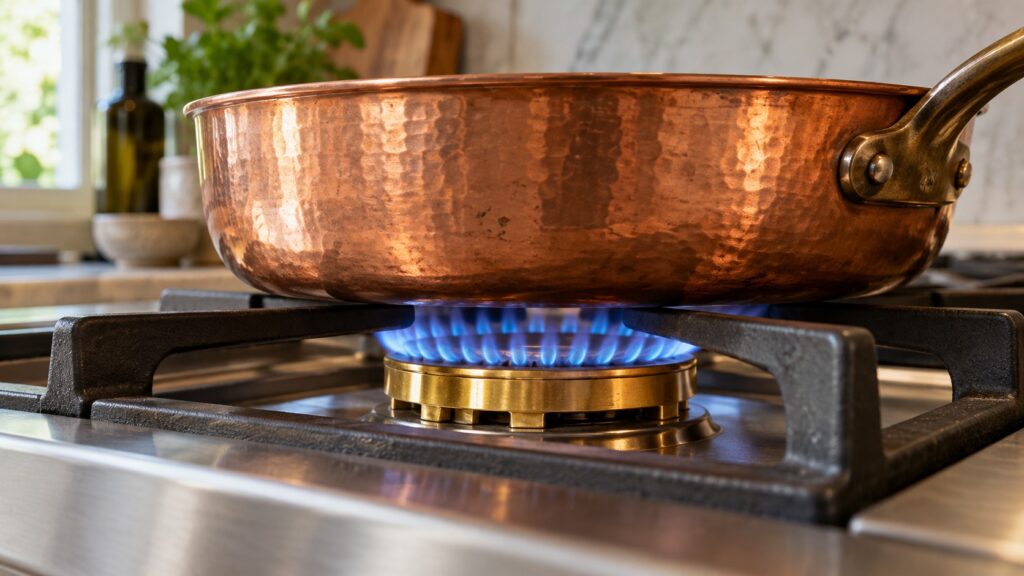
How La Cornue gas burners work is a short chain: turning the knob opens a valve and triggers a spark, gas flows to the burner and mixes with air, the spark lights the mixture, and the flame heats the pan. Each link depends on the one before it, so a burner that will not light, clicks without catching or burns yellow always traces back to a break somewhere in that chain: gas supply, air mix, spark or the parts you can see and clean.
What happens when you turn the knob on a La Cornue burner?
The knob does two jobs at once. It rotates a valve stem that lets gas flow toward the burner, and it presses a switch that sends a signal to the spark module. In the first moments you hear a rapid clicking while gas flows and the electrode sparks. If the gas and the spark meet at the right place, the burner lights with a soft whoomp, the clicking stops once the flame is steady, and you can adjust the height with the knob. A knob that is stiff or loose affects both jobs; our guide to a stuck or stiff burner knob explains what to do.
How does the burner mix gas and air?
Gas leaves the valve through a small hole called an orifice, and the jet of gas pulls air in through an opening beside it, a process called primary air. The mixture travels along a short tube to the burner crown, where it leaves through a ring of tiny ports. The proportions matter. Too little air gives a lazy, yellow, sooty flame. Too much air gives a noisy flame that lifts away from the ports and can blow out. A properly set burner gives a quiet, steady blue flame with short cones.
The orifice size is matched to the fuel, which is why converting from natural gas to propane needs the right parts. Our guide to converting a La Cornue from natural gas to propane explains why that job is not a matter of turning a screw.
What does the spark do, and why does it click?
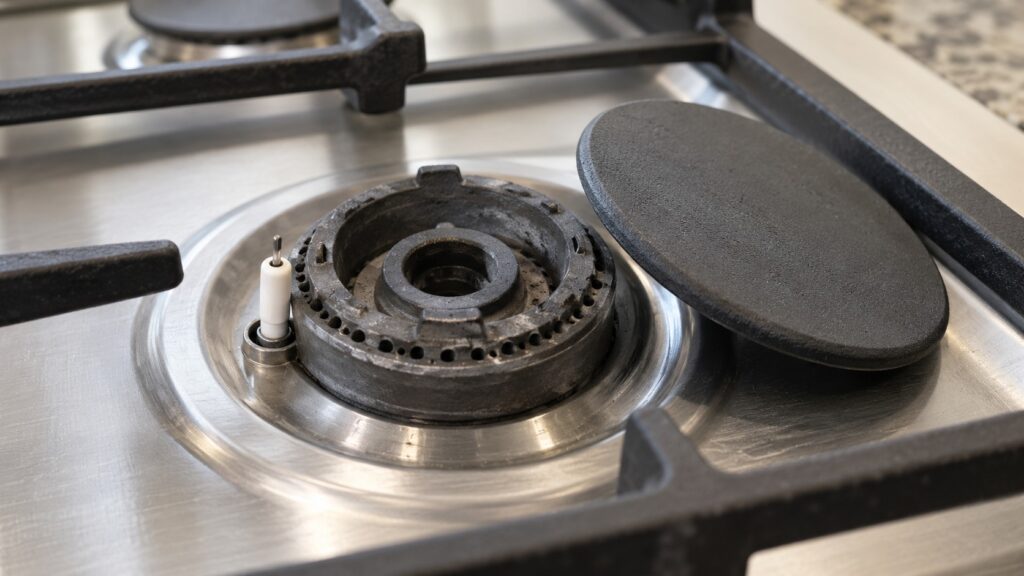
The spark module is a small electronic box that makes a high voltage pulse many times per second, and the pulse jumps across a gap between the electrode tip and the burner. The clicking you hear is that spark. It continues until the flame lights, then stops. If the spark is weak, the electrode is dirty, or the gap is wrong, the gas flows but nothing lights, and you hear clicking without a flame. If the module fails, you hear nothing at all.
That is why wet or dirty parts matter. A boil-over that lands on the electrode, or a cap sitting on a crumb, interrupts the spark’s path. Our guide on a clicking igniter that will not light walks through the checks, and the broader range will not light checklist puts them in order.
Why do the caps and crowns matter so much?
The cap and crown are not decoration. The crown holds the ports in a precise ring, and the cap sits on top and shapes how the flame spreads. If a cap is not seated flat, or a port is blocked, the flame is lopsided or fails to carry from one port to the next, and the burner may light only partly or not at all. Cleaning the parts correctly keeps the flame even, and our guide to burner caps and grates care shows how, including why metal pins and drill bits ruin ports.
What does the flame color tell you?
A blue flame with short, defined cones means a good mix of gas and air. A yellow or orange flame, or one that leaves soot on pans, means too little air or dirty ports. A flame that stands off the burner or roars means too much air or a pressure problem. Occasional orange flecks are normal when cooking splashes land on the burner, but a persistent yellow flame is a fault. Our guide to a weak or yellow flame covers the causes, and the simmer and low heat tips explain why a low flame behaves differently from a high one.
How is the burner kept safe?
Gas appliances are built around the possibility that a flame goes out. Many modern burners include a flame-failure device that shuts off gas if no flame is detected, and the valve itself is designed to close when the knob is off. None of this removes the need for care. If you ever smell gas, do not turn on a light, use a phone in the room or try to light anything. Leave the area, then call your gas utility from outside. Our guide on La Cornue gas smell safety steps lists the steps.
Repairs to the valve, the regulator and the gas connections are work for a qualified technician, never for the owner. A failed valve is a repair rather than a replacement of the range, and our guide to replacing a La Cornue gas valve explains what is involved.