Professional burners are bought for their high end and judged on their low one. A La Cornue simmer that will not hold — a flame that goes out under a lid, or one that sits stubbornly too high — is the single most common cooking complaint we hear about these ranges, and it is usually technique, cookware or a five-minute cleaning job rather than a fault.
What a low flame actually needs
A gas flame at its lowest setting is a small amount of gas burning with just enough air. Take away a little air — by covering the pan tightly, by blocking part of the crown, or by seating the cap crooked — and the flame has nowhere near the margin it had at full output. It goes out, and the natural reading is that the burner cannot simmer.
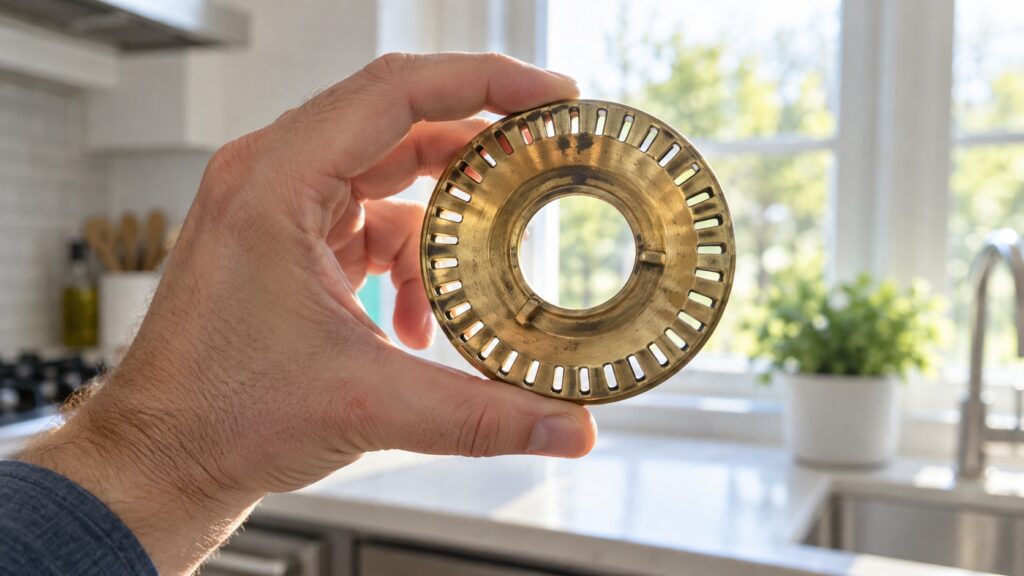
The fix is usually to give it air. Crack the lid rather than clamping it. Make sure the crown slots are open along their whole circumference — hold the crown up to the light and look through the slots rather than glancing at it. And reseat the cap so it lies flat.
Cookware does more for simmer than the dial
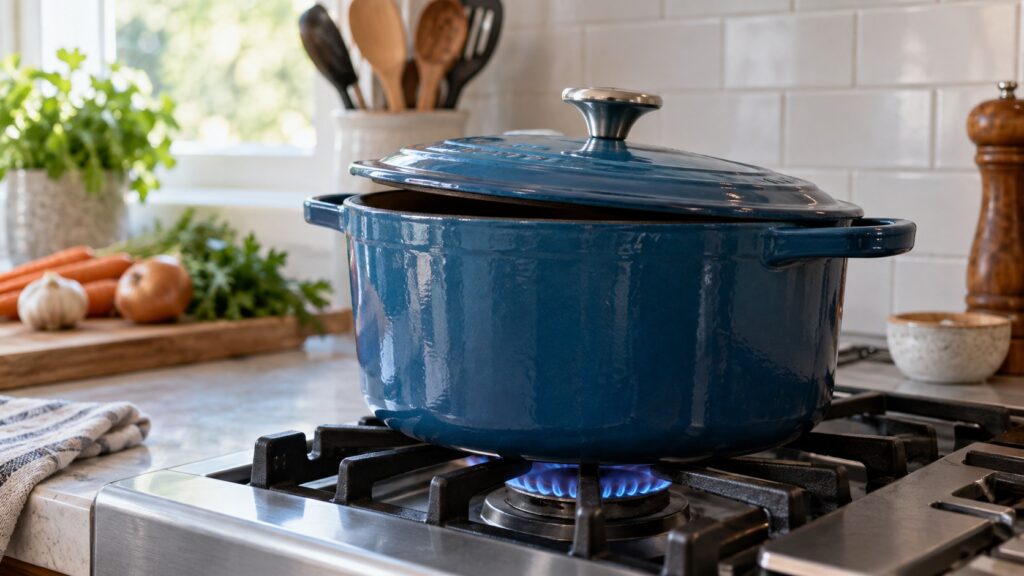
At a low setting the burner is delivering very little heat, and what happens next is entirely up to the pan. A thin pan transmits that heat straight to a small area of its base, which boils while the rest of the pan is merely warm. A heavy pan spreads it, and the whole base sits a few degrees below boiling — which is what a simmer is.
- Heavy base, always. Cast iron, clad stainless with a thick disc, enameled cast iron. Thin stainless will never simmer well on any burner.
- Match pan to burner. A small pan on a large burner catches flame up the sides, which heats the pan wall rather than its contents.
- A diffuser is legitimate. For the very lowest work — melting chocolate, a long stock — a simmer plate costs little and works.
- Lids change everything. A tight lid raises the temperature inside and starves the flame outside. Use a cracked lid for both reasons.
The monthly clean that keeps the low end
Simmer degrades gradually as residue accumulates in the crown slots, and because it is gradual nobody notices until the burner will no longer hold what it used to. Lift the cap and crown monthly, check the slots against the light, clear anything blocking them with a pin rather than a knife, and let both parts dry fully before refitting.
🔴 A crown refitted while still damp is the most common cause of a burner that clicks and will not light — the spark tracks across the moisture instead of jumping to the gas. Our page on a clicking igniter covers that, and the surface care guide covers the cooking top around it.
Using the French top instead
If the range has one, the French top is the better tool for anything that needs to be held gently for a long time. It is a solid plate heated from the center, so it offers a whole map of temperatures at once: fierce in the middle, gentle at the edge. A pot moved outward two inches is a simmer adjustment made without touching any control.
For stocks, braises and anything that needs hours rather than minutes, that is a more stable arrangement than any burner at its minimum. Our guides on how the French top works and cooking on it cover the technique.
Induction simmering is a different problem
On an induction module the low end is electronic rather than physical, and the failure mode inverts: instead of going out, a low setting pulses. The zone delivers full power briefly and then nothing, repeatedly, which shows up as a sauce that boils in bursts against the pan base. A heavy pan smooths that out by absorbing the pulses; a thin one passes them straight through.
The same heavy-base rule therefore applies for the opposite reason, and it matters more rather than less. Our cookware guide for induction covers what works.
Reading the flame instead of the dial
Dials on these ranges are marked, but the marking is a guide rather than a measurement — the same position on two burners of different sizes delivers different heat, and the same position at the start and end of a long cook can behave differently as the burner warms. The flame itself is the better instrument, and it takes about a minute to learn to read.
A good simmer flame is small, entirely blue, sits down on the crown rather than standing up from it, and is continuous all the way around. A flame that has gaps around the circumference is a partly blocked crown. A flame standing off the crown with a gap underneath is about to go out. A flame with yellow at the tips is burning short of air. None of those need a tool to diagnose — they need looking at once, deliberately, rather than glancing at while stirring.
When it is the burner rather than the technique
Three patterns point away from technique. A single burner that simmers differently from its neighbors, after the crown has been cleaned and the cap reseated, is that burner. Lazy yellow flames on every burner point at gas type rather than at any of this — see the yellow flame page. And a burner that has changed suddenly, rather than drifted, has had something happen to it.
We are an independent repair company, not a factory service arm. Pricing starts from a diagnostic visit and we confirm the estimate before any work begins. La Cornue range repair covers the burners and the valves behind them, and you can schedule a visit online.