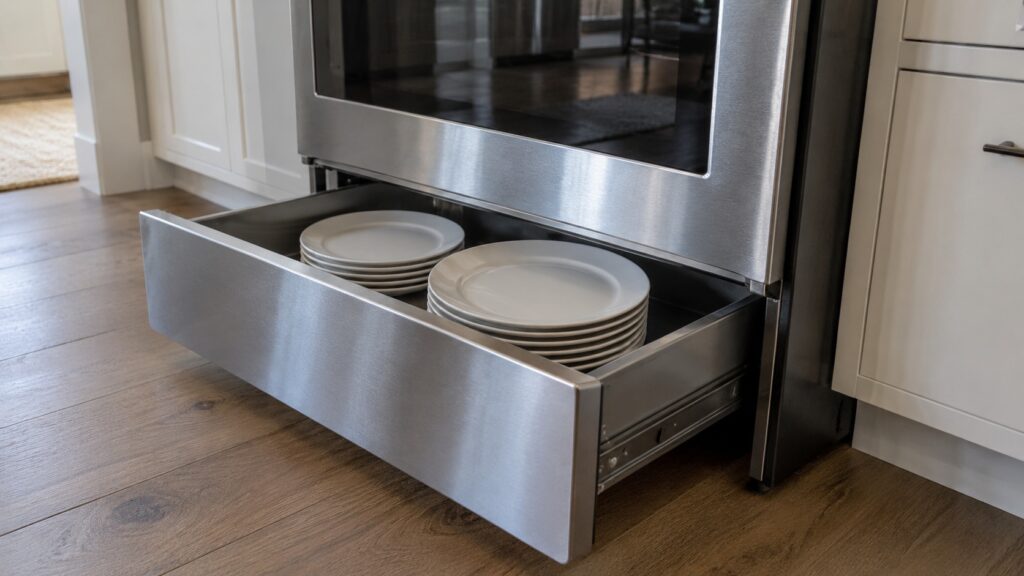
Is a La Cornue warming drawer worth fixing? In almost every case, yes. A warming drawer is a simple appliance with few parts, and its common faults are mechanical or small electrical items rather than a reason to replace a range. A drawer that drags, sticks or will not close flush is usually debris in the slide track, a slide out of alignment or a range that has gone out of level. A drawer that does not warm points at the heating element or its control. A drawer that gets too hot points at a thermostat that has lost calibration, and that one deserves prompt attention. This guide helps you sort which case you have and when a technician is the right call.
What can go wrong with a La Cornue warming drawer?
According to our guide on how La Cornue warming drawers work, there is very little to fail: the element, the thermostat, the control and the drawer runners are the whole list. The drawer holds food at a serving temperature rather than cooking it, using a low-output element, insulation and a humidity vent. Because the parts are few and the drawer is built into the base of the range, almost every fault can be traced to one of those four items, and each of them can be repaired or replaced on its own.
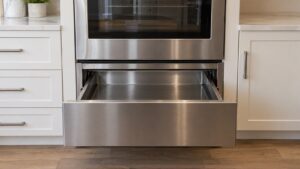
The drawer sits low on the range, in the position most exposed to spills, knocks and heavy loads, which is why the runners tend to need attention more often than the element. Our warming drawer misalignment guide goes into the mechanical side in detail.
When is a sticking or crooked drawer worth fixing?
Always, because it is the cheapest category. Empty the drawer first and open and close it slowly, watching both sides of the slide. Crumbs, a dropped utensil or packaging left from installation can jam a track, and a narrow vacuum attachment followed by a dry cloth clears most debris without taking anything apart. If only one side drags, one slide is out of alignment, which usually means a small, targeted adjustment. Check the range level in both directions with a level tool, because a range that has shifted can make a healthy drawer feel faulty; our leveling and anti-tip guide covers it. None of these checks require opening the base panel. If a drawer has dragged since a period of heavy loading, tell the technician, as that points to wear from load rather than a defect.
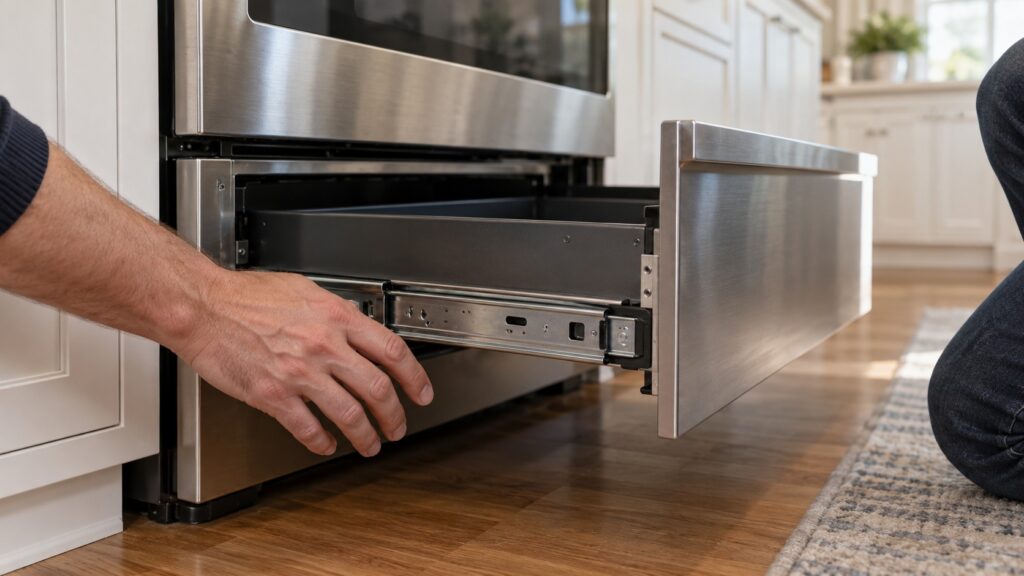
What does it mean if the drawer closes but does not warm?
That is a separate problem from the slides. It points to the heating element or the control that drives it. Remember that a thermostat cycles the element on and off, so a drawer can feel cool for a short time between cycles without being faulty; if it never warms at all after a reasonable wait, book a technician. Warming drawers use mains power, so the element and its wiring are not owner repairs. Do not open the base of the range to look. A technician can tell whether the element, the thermostat or the control has failed and quote that one part, which usually makes more sense than the disruption of replacing the range.
What if the drawer gets too hot?
This is the fault to take most seriously. A drawer that runs hotter than its setting is usually a thermostat that has lost calibration, and it turns a holding appliance into something closer to a slow cooker. Stop using it to hold food and have it checked. For food safety, our warming drawer guide says hot food needs to stay above 140°F, so if you ever rely on the drawer to hold a dish for a long time, put a probe thermometer in the thickest part once to confirm what your drawer actually does at that setting. Dials drift. If the drawer is too hot to touch on the outside, smells of burning, or shows sparks or smoke, switch off the breaker at the panel while standing on a dry floor and call a technician.
When does replacing something make sense?
Replace the part, not the appliance. Worn runners on a drawer loaded heavily for years are a runner replacement. A failed element is an element replacement. The case for more is very narrow: a drawer body that is physically damaged, or a drawer that no longer fits because the cabinet or range is being changed during a remodel. Our cost to repair a La Cornue range guide discusses how to think about repair cost, and our warranty guide describes a five-year parts and labor warranty; confirm the exact terms for your model. We do not quote prices here; a technician confirms an estimate before any work begins.
What should you do before calling?
Write down what the drawer does: does it drag, stick, fail to heat or overheat, and does it do so empty? Note whether the range is level, and how heavily the drawer is usually loaded. Do not hang heavy serveware in a drawer that has started to drag. If you are comparing a repair against a bigger change, look at our range repair page to see how a visit works, then schedule a visit.