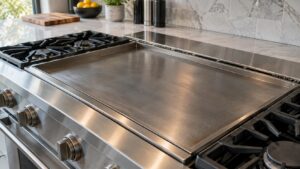
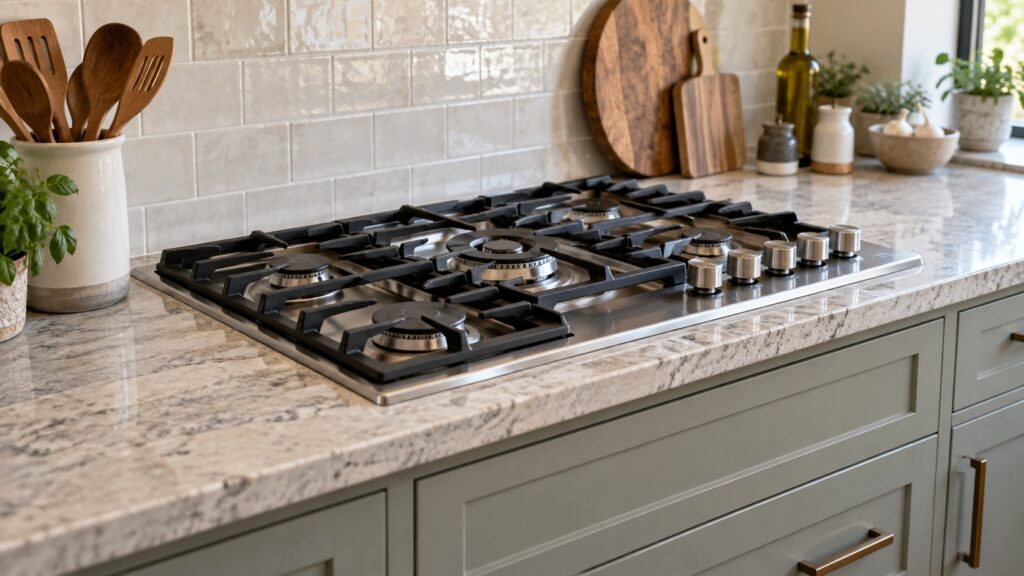
A La Cornue rangetop is a cooking surface without an oven beneath it, dropped into a counter cut-out and finished to the same standard as the ranges. La Cornue rangetop installation is therefore a joinery job as much as an appliance one: the cut-out, the cabinet below, the gas and the ventilation are all decided before the unit arrives, and none of them is easy to correct afterwards.
The cut-out is the decision with no give in it
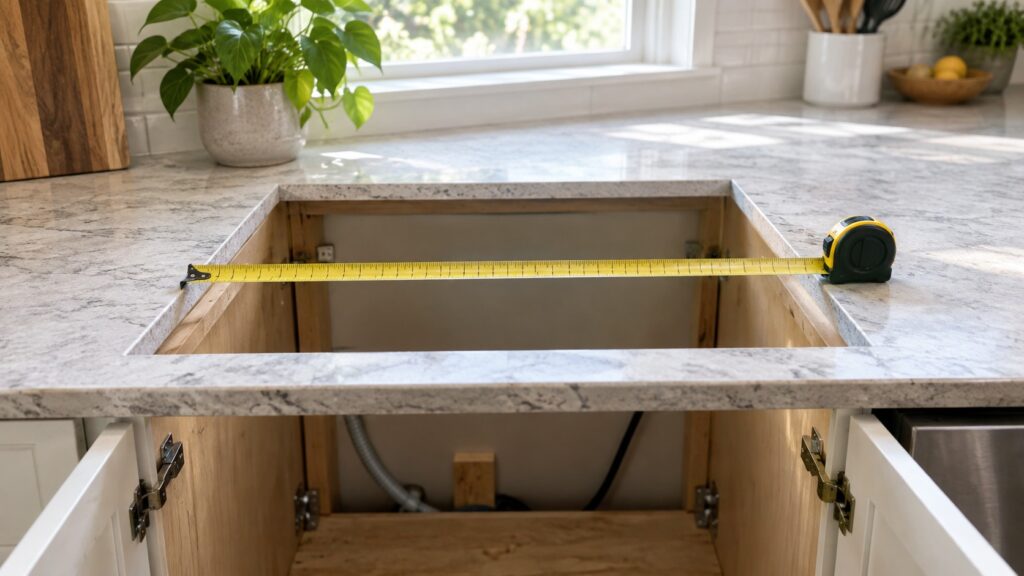
Everything else on this page has some tolerance. The opening does not. The unit sits on the counter with its own flange overlapping the cut, so the cut has to be square, level and within the specified size. Too large and the flange no longer covers it; too small and the unit will not drop.
Two details catch people out on stone. The corner radius: a fabricator cutting with a standard bit leaves rounded corners, and the flange has to cover them — check the radius against the drawing before the stone is cut, not after. And the front-to-back position, which decides whether the control knobs clear the drawer or door beneath. Measure from the finished front edge of the counter, because an overhang moves everything.
Gas, and the supply people forget
The gas connection is licensed trade work in essentially every jurisdiction, and it is not a place to save money. What gets forgotten is the second supply: the spark ignition and the controls need electricity, which means a grounded outlet, usually in the cabinet below, positioned so it stays reachable after the cabinetry is finished.
- Natural gas or propane is an order-time decision. Conversion needs the correct orifice kit and a qualified technician — see our conversion guide.
- The shutoff valve belongs where a person can reach it without pulling the unit out.
- Flexible connector length should let the unit come forward for service without straining the line.
- Leak test at commissioning, with solution and never a flame. Any smell afterwards means stopping and following the gas smell steps.
The cabinet underneath is usable, and that is the problem
Because there is no oven, the space below a rangetop becomes storage — and that is where installations quietly go wrong. It has to stay ventilated, the outlet has to stay accessible, and it must not turn into a sealed box packed with cardboard and cleaning products. Clearances to cabinet sides and to any combustible surface are specified by the model and are not negotiable.
Leave the unit removable. A rangetop caulked into a stone counter around its whole perimeter can only be lifted by breaking the seal, and every future service visit then begins with that job.
Ventilation is sized by heat, not by width
Professional burners put a great deal of heat and moisture into a room, and hood capacity is chosen against the total output of the burner set and the duct run — not against the width of the appliance. An undersized hood does not announce itself: it shows up as grease on cabinet doors several feet away, a kitchen that stays warm long after cooking, and condensation on windows in winter.
Duct matters as much as the fan. Every elbow and every foot of flexible duct costs airflow, and a long run through a joist space can halve the number on the box. Our venting guide covers the run and the sizing guide covers the figure.
Getting it into the room
These units are heavy and the grates are the heaviest removable part. Take them off first, along with the burner caps and crowns, and box them together so nothing is refitted to the wrong burner — crowns are not always interchangeable between burner sizes, and one on the wrong base gives a flame that looks nearly right and never simmers.
Protect the counter edge on the way in. Stone chips at the cut-out edge, and a chip there is permanent and sits directly under the flange where you will see it every day.
Commissioning: the checks that end the job
A correct installation finishes with tests, not with the last screw. Every burner should light within a couple of seconds, on the first click, from cold. The flame should be blue and stable, with no yellow tipping and no lifting off the crown. Every burner should hold a low simmer without going out. Nothing should rock.
If one burner behaves differently from its neighbors, that is usually the burner. If all of them click and none light, that is the shared spark system or the power supply — see our page on a clicking igniter. Lazy yellow flames across the whole unit point at gas type rather than at the burners; the yellow flame page covers that.
Counter material, and the heat it has to live with
A rangetop runs hot along its flange and puts sustained heat into whatever the counter is made of. Granite and sintered stone take it without complaint. Engineered quartz is more sensitive: its resin binder discolors with prolonged heat, and a narrow strip of counter between the cut-out and a wall or a sink can take more than it was designed for. Laminate should not be in contact with the flange at all.
The rule that keeps everyone out of trouble is to respect the model’s specified clearance to any adjacent vertical surface and to avoid narrow slivers of counter beside the unit. Where a sliver is unavoidable, the stone fabricator should be told what is going next to it before the template is cut, not after.
When to call
We are an independent repair company, not an installer, so we have nothing to sell you on this job. What we see is the aftermath of installations where the commissioning checks were skipped: units that were never leak-tested, cabinets sealed shut, and hoods sized by width. Our guide on faults that are really installation problems covers how those present months later.
If the unit is in and something is not right, La Cornue rangetop repair starts with a diagnostic visit and we confirm the estimate before any work begins. You can schedule a visit online, and the configuration guide covers the widths and modules if you are still choosing.