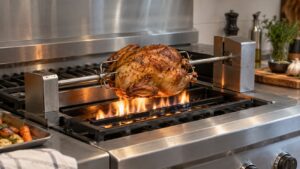
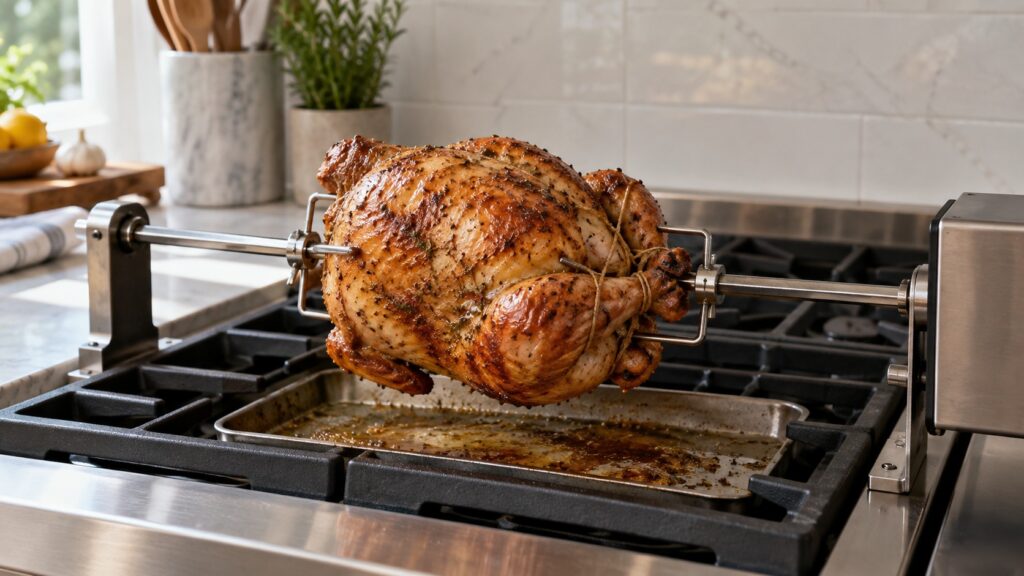
Good La Cornue Flamberge cooking tips start from one fact about the module: it delivers direct, open radiant heat from a single fixed gas burner rather than the circulated, even heat of an enclosed oven rotisserie. That single difference changes how you should truss, load, and monitor whatever is turning on the spit, and ignoring it is the most common reason home cooks get uneven results on their first few attempts with the Flamberge compared to an oven rotisserie they may be used to. Once you adjust for that difference, the module tends to produce results people specifically associate with open-fire spit roasting, which is exactly the point of choosing it over an enclosed rotisserie in the first place.
Why does trussing matter more on the Flamberge than in an oven rotisserie?
Because heat comes from one fixed direction rather than circulating evenly around the food, any part of the item that sits farther from the burner during rotation cooks more slowly than the part that swings closest to it. Loose limbs, an unevenly tied bird, or a roast that shifts partway through the cook all create exactly that kind of inconsistency — parts of the food get more direct exposure than others simply because they are not held in a stable, centered position as the spit turns. Tight, even trussing keeps the food’s shape consistent and its distance from the burner as even as possible throughout the entire rotation.
How should you think about heat distance and burner adjustment?
The Flamberge’s gas flow is adjustable independently of the spit’s rotation speed, which gives you real control over how aggressively the surface sears without needing to change how fast the food turns. Starting with a moderate flame and adjusting up if you want more color and char, rather than starting high and risking a scorched exterior before the interior catches up, tends to give more predictable results, especially the first few times you use a specific size or cut on the module. Because there is no enclosed chamber trapping and circulating heat, the burner setting has a more immediate and noticeable effect on cooking speed than an oven’s temperature dial would.
What should you watch for once the spit is turning?
Check on the food periodically rather than walking away for the full cook time, since the open-heat setup means flare-ups from dripping fat, an unexpectedly fast-browning section, or a drip tray needing attention mid-cook are all more likely here than in an enclosed rotisserie. This does not mean the Flamberge needs constant hovering, but it does reward more periodic attention than a “set it and forget it” oven rotisserie cycle would. Checking every ten to fifteen minutes during a longer cook is usually enough to catch a flare-up or an uneven brown patch early, before it becomes a real problem with the finished result.
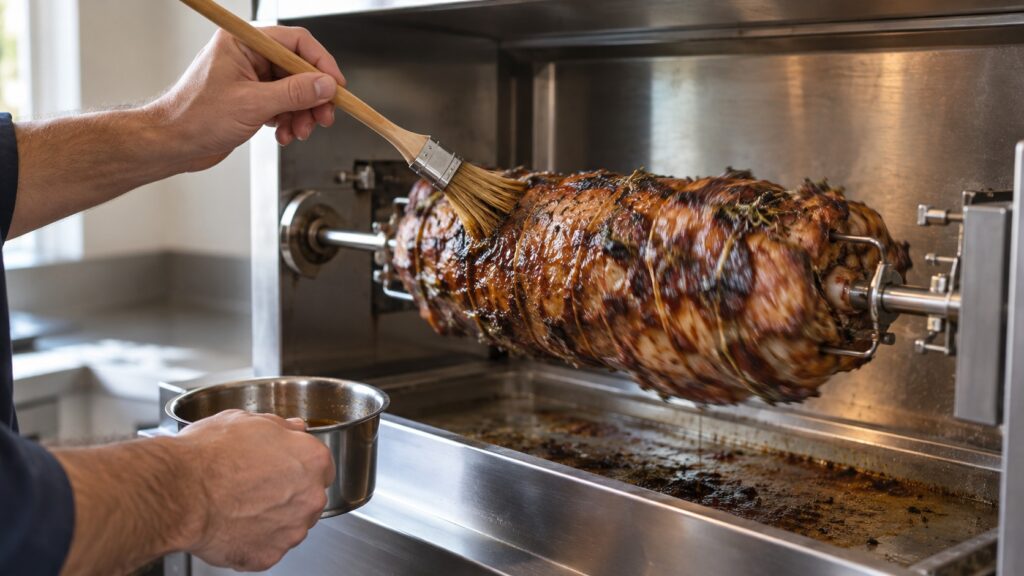
Basting, if your recipe calls for it, is best done while the spit continues turning rather than stopped, so the coating goes on somewhat evenly across the rotation rather than pooling on whichever side happened to be facing up when you paused it. A long-handled basting brush makes this easier and keeps your hand at a safer distance from the direct heat. Applying baste in short, quick passes as each side comes around, rather than trying to coat the whole surface in one long pause, works with the rotation instead of against it.
Should you rest the food after taking it off the spit?
Yes, in the same way you would rest any roasted meat, and arguably more so given how direct the Flamberge’s heat is. A short rest — ten to fifteen minutes for a whole bird, longer for a larger roast — lets juices redistribute through the meat rather than running out the moment you carve, and it also gives the exterior a chance to settle after the intense, direct heat it was exposed to during cooking. Skipping the rest to serve immediately is a common reason people feel a Flamberge result was drier than expected, when the cooking itself was actually fine.
What load sizes and shapes work best on this module?
Compact, evenly shaped items — a well-trussed whole chicken, a rolled and tied roast — generally perform more predictably on the Flamberge than long, irregular, or asymmetric shapes, simply because they rotate more smoothly and present a more consistent surface to the burner throughout the cook. If you are cooking something naturally irregular, extra care with trussing to bring it into as compact and even a shape as possible pays off more here than it would with an enclosed rotisserie that is more forgiving of an imperfect load.
Weight matters too, within reason. Very large loads ask more of the spit motor and can take considerably longer to cook through evenly on open, direct heat than a similarly sized item would in an oven’s circulated environment. If you are cooking something on the larger end of what the module is rated for, budget extra time and check for doneness with a thermometer rather than relying on visual browning alone, since a well-charred exterior on the Flamberge does not always mean the interior has caught up yet.
What should you do if results are consistently uneven despite good technique?
- Recheck trussing and balance first — this solves more uneven-cooking complaints than any adjustment to heat or timing.
- Confirm the spit is turning at a normal, steady speed without stalling or wobbling under the load.
- Check the drip tray’s position and fill level, since a tray issue can cause flare-ups that scorch one side unevenly.
- If the spit itself is struggling to turn smoothly even with a well-balanced load, that points at a mechanical issue rather than technique, and no amount of adjusting trussing or burner heat will fix a motor or gearing problem.
For the mechanism behind these tips, see our how the Flamberge rotisserie works guide, and for the term itself, our Flamberge glossary guide. If the spit will not turn or heat correctly no matter how well the food is loaded, see our Flamberge won’t turn fix guide, or schedule a visit for a hands-on check.