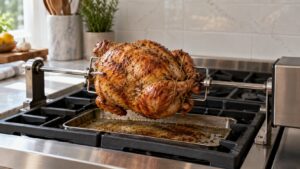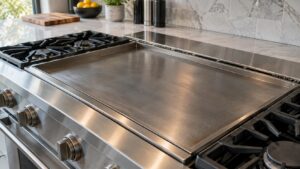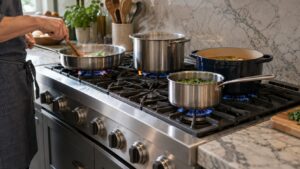
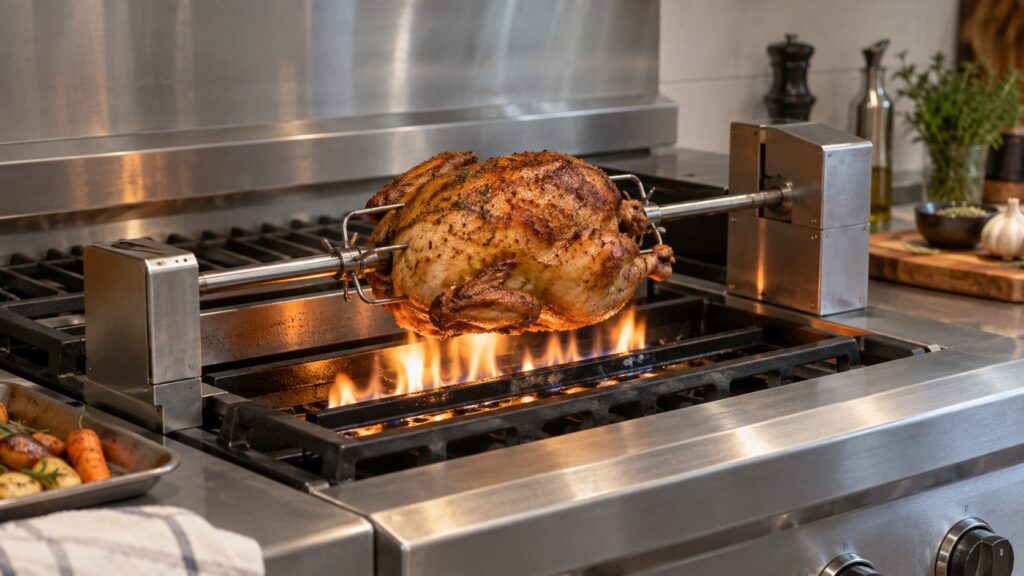
How La Cornue Flamberge rotisserie works is genuinely different from an oven rotisserie or a standalone electric rotisserie appliance. A gas burner sits below or behind the rotating spit, radiating direct heat onto the meat as a motor turns the spit at a slow, steady speed — closer in principle to a traditional spit-roast over an open flame than to the enclosed, fan-assisted rotisserie mode found in many ovens. Understanding that mechanism explains both why the Flamberge produces results people compare to open-fire roasting, and what to check first if it stops turning or stops heating. The Flamberge is a rotisserie module built directly into the rangetop rather than a separate appliance, which is part of why its mechanism is worth understanding on its own rather than assuming it behaves like a rotisserie attachment you might have used elsewhere.
Why does the Flamberge use direct gas heat instead of an enclosed oven-style rotisserie?
The Flamberge is built around the idea of spit-roasting the way it was traditionally done — with radiant heat playing directly across the surface of the meat as it turns, producing a sear and rendering fat in a way an enclosed, fan-assisted oven rotisserie cannot quite replicate. The tradeoff for that open-heat approach is that it needs more active attention than a closed oven system: heat is not being evenly circulated by a fan, so positioning, spit speed, and burner adjustment all matter more to the final result than they would in an enclosed rotisserie mode.
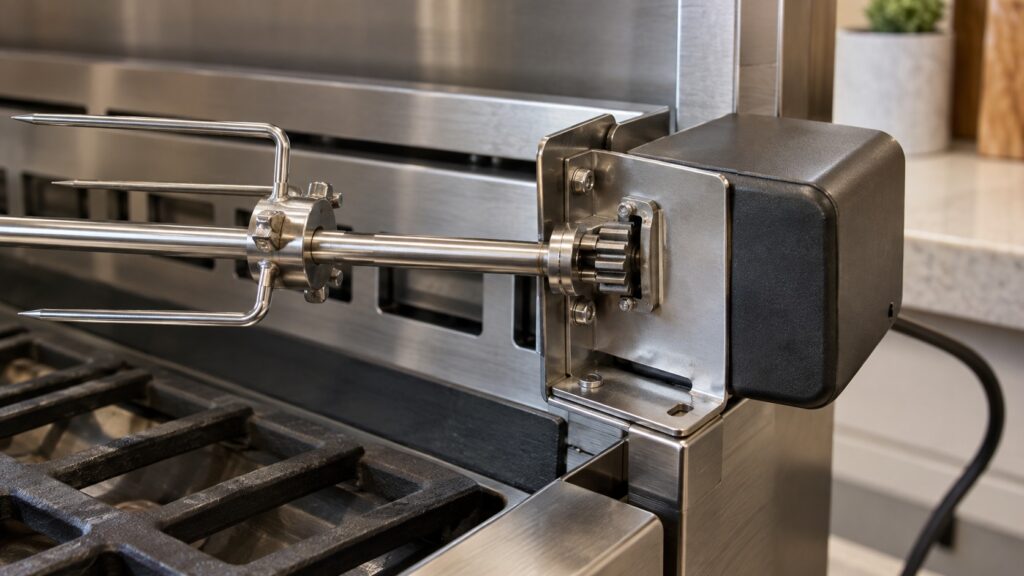
How does the spit actually stay turning at a steady speed?
A small electric motor drives the spit rod through a gear mechanism, turning it slowly and continuously throughout the cook. This motor is a separate system from the gas burner supplying heat — you can adjust flame intensity without affecting rotation speed, and the motor itself runs at a fixed or lightly adjustable speed depending on the model. Because the motor and the burner are independent systems, a problem with one does not necessarily mean the other has failed: a spit that has stopped turning while the burner still lights and heats normally points at the motor or its drive mechanism, not at the gas supply. That distinction alone rules out an entire category of possible causes before a technician even arrives, which is often the single most useful piece of information you can pass along when describing the problem.
What role does the drip tray play beyond catching mess?
The drip tray beneath the spit does more than keep the module and rangetop clean — it also affects how the module cooks. Rendered fat and juices that collect in the tray can smoke or spatter if allowed to overheat, and a full or improperly positioned tray changes the airflow and heat pattern around the spit. Keeping the tray at the correct level of fill and correctly seated is part of what keeps the Flamberge cooking predictably, not just a cleanup convenience. A tray that has been emptied and reseated incorrectly can sit slightly off level, which changes where fat and juices pool during a long cook and, in some cases, brings them closer to the burner’s flame than intended.
Does the size of the burner flame need to change during a long cook?
Often, yes, though not on a fixed schedule. Many cooks start at a moderate flame to build initial color and then adjust down partway through a long cook, once the surface has developed the sear they want, to avoid over-charring the exterior while the interior finishes cooking through. Because the burner and the motor are independent, this adjustment can be made at any point in the cook without stopping the spit or affecting rotation speed at all — you are only changing how much radiant heat is reaching the meat, not how it is being turned. Watching the exterior color rather than following a fixed timer for flame changes tends to give more consistent results across different sizes and cuts.
Why does positioning the food on the spit matter so much?
Because heat comes from one fixed direction rather than circulating evenly around an enclosed chamber, how the meat is skewered and balanced on the spit has a bigger effect on the Flamberge’s results than it would in an oven rotisserie. Meat that is unevenly weighted on the spit puts uneven strain on the motor and can cook unevenly, since the side facing the burner longer during any wobble gets more direct exposure. Trussing and balancing the food carefully before starting the motor is a genuine part of getting consistent results from this mechanism, not just a cooking preference. This is also why heavier or irregularly shaped items ask more of the motor than a well-balanced, evenly trussed bird does — the gearing has to work harder against an imbalance every single rotation, which over a long cook adds up to more mechanical stress than most people would expect from what looks like a simple turning motion.
What does this mechanism tell you about troubleshooting?
Because the burner and the motor are separate systems, most Flamberge problems fall cleanly into one category or the other. No heat with normal spit rotation points at the gas supply, the igniter, or the burner itself. Normal heat with a spit that will not turn, turns unevenly, or stalls under load points at the motor, its gearing, or an imbalance in how the food was loaded. Identifying which system is actually at fault before assuming the whole module needs service saves time and helps a technician bring the right part on the first visit.
It is also worth checking the drip tray and spit balance before assuming a mechanical fault at all. A spit that struggles to turn smoothly is sometimes simply carrying an unevenly loaded piece of meat that is fighting the motor’s steady speed, rather than a motor or gearing problem — removing the food, checking the spit turns freely on its own, and then reloading it more evenly is a useful first step before concluding the motor itself has failed.
For the glossary definition of Flamberge itself, see our Flamberge glossary guide, and for cooking technique once you understand the mechanism, see our Flamberge cooking tips. If the module has stopped turning or heating, our Flamberge won’t turn fix guide covers the next diagnostic steps. You can schedule a visit if the issue needs a hands-on look.