
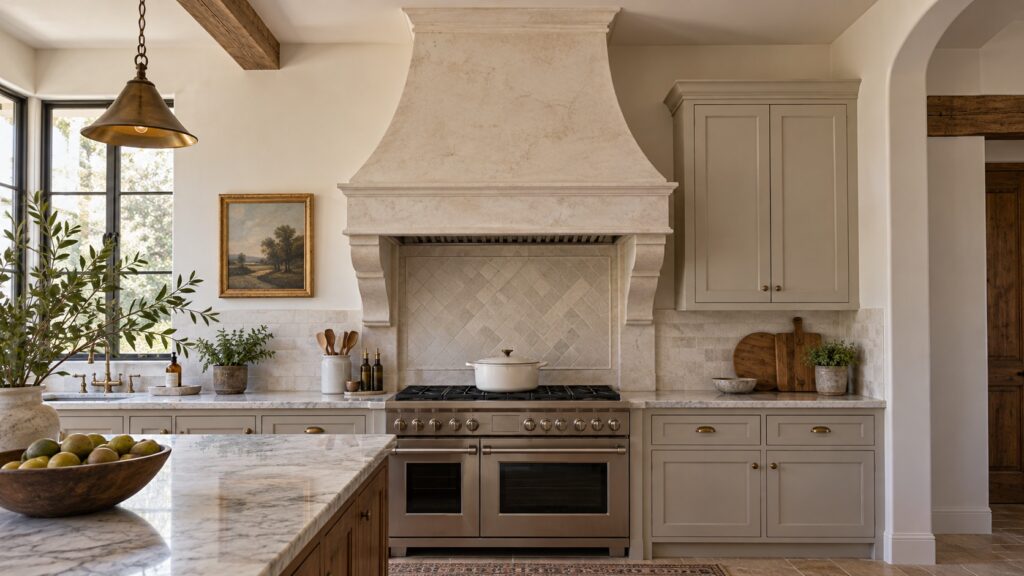
A La Cornue Marquee hood installation, like the Loge and Cascade, follows the same order as any heavy wall hood: find the installation sheet for your exact model, set the mounting height over the cooking surface, make sure the wall will carry the weight, plan a short straight duct to the outside, and have the electrical supply connected by a qualified person. The three hoods are CornuFé styles that differ in silhouette, and the silhouette changes how each one meets the wall, the ceiling and your cleaning access. This guide is a planning checklist for those three styles. It gives no dimensions or weights, because the installation sheet for the model gives them, and the lifting, wall and electrical work belong to an installer.
What do the Marquee, Loge and Cascade hoods have in common?
Our model pages list all three, along with the Euclid, as CornuFé hoods sized to the CornuFé 90 and 110 ranges, with a four-speed blower, baffle filters and a four-speed switch with lighting. Our hood names glossary says the names describe the silhouette and not a difference in ventilation performance for a given size. That is useful for planning: the installation steps are largely the same, and what changes is how the shape meets your room. Château hoods are different; they are sized by range width.
Because the specification table is the same for these hoods, the only reliable way to separate them is the installation sheet for the specific hood. Find the model name on the label or the carton and keep the sheet beside you throughout.
How does each silhouette change the planning?
Our Marquee vs Loge guide says the Marquee profile projects forward and reads as a single strong horizontal, which suits a room built around the range but can feel close overhead in a compact kitchen or under a low ceiling. Measure from the cooking surface to the underside of the hood against the model’s specification, then stand at the range and picture that volume above you. The Loge reads as a mantel and asks more of the wall behind it and of the surrounding finish work. A wall that is not flat, or cabinetry that was not planned around it, shows the mismatch.
The Cascade is described as a sweeping curved canopy. Our pages do not say more about its mounting, so rely on its installation sheet for how the canopy meets the wall and ceiling. If you are still choosing between styles, ask to see the hood in a showroom before the wall is closed.
How high should the hood go, and what supports it?
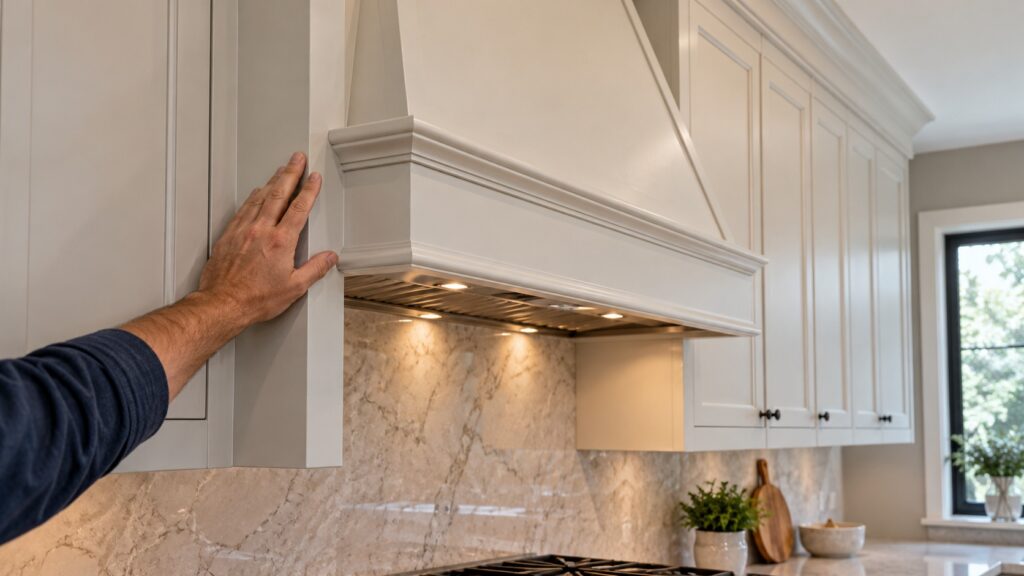
The height is the clearance in your model’s installation instructions, measured from the cooking surface to the lower edge of the hood. Our hood height guide explains that too high loses capture and too low risks heat damage, and it does not guess at inches. Measure at the front and the back of the cooking area, because a hood that is slightly out of level gives two readings.
These are heavy decorative hoods. Our Euclid installation guide, which describes the same CornuFé hood family, says the wall must hold the load, with studs or solid blocking behind the mounting points, not drywall alone. If the wall is already finished, an installer can open it, add blocking and repair it. Two or more people are needed to lift the body into place. See our Euclid hood installation guide for the sequence.
What should the duct and the electrical supply look like?
A hood is only as good as its duct. Our venting guide says to use smooth, rigid metal duct rather than flexible foil, keep the run short and straight, avoid sharp elbows and vent to the outside. The duct size for your CornuFé hood is on its own installation sheet; use that size and do not reduce it. High-output hoods can depressurize a tight home, and local codes may require make-up air, so confirm with your installer. Our sizing guide explains how width and airflow relate to the burners below.
The hood needs an electrical supply that matches its sheet, normally a switched, grounded circuit. Have a qualified electrician make the connection, and turn the breaker off before anyone reaches into the wall. If any wiring in the wall looks damaged, stop and call an electrician.
Who should be on site during installation?
At least two people for the lift, an installer who knows the wall and duct, and an electrician for the connection. Have the designer or cabinetmaker present if the hood meets cabinetry on either side, because a mantel or projecting profile shows any gap or out-of-square joint. Agree beforehand where the duct will exit, who supplies the duct and who seals it, so nothing is left to the end of the day.
What should you check once it is up?
The hood is level in both directions and tight against its mounting points. The duct is sealed at each joint and the damper opens freely. The blower runs smoothly at each speed without rattling. The lights work, and you know how to replace a lamp; our halogen replacement guide covers that. The baffle filters come out and go back easily. If suction seems weak, a duct that is too long or too narrow is a common cause; see our weak suction guide.
We are an independent repair company, not the manufacturer. Our La Cornue range hood repair page explains how a visit works, and you can schedule a visit online if something is not right after installation.