
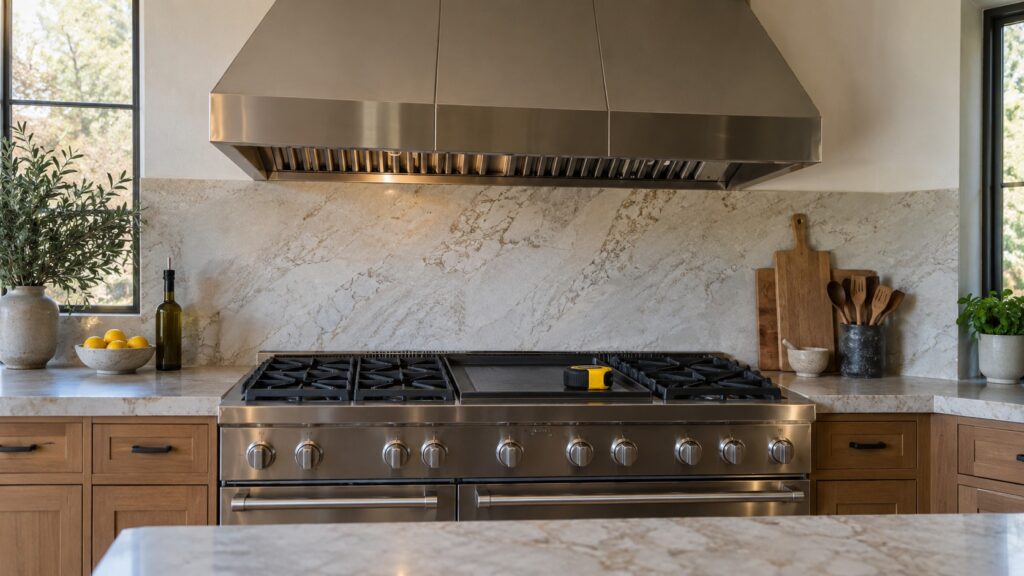
The right La Cornue hood height above range is the clearance in your model’s installation instructions, measured from the cooking surface to the lower edge of the hood. We do not publish a single number, because it depends on the hood and the range under it. Our venting guide gives the principle: follow the manufacturer’s recommended clearance, because a hood mounted too high loses capture and one mounted too low risks heat damage and code problems. This guide shows how to measure, what to check, and who should do the work.
How high should a hood be above a La Cornue range?
High enough to stay clear of the heat from a powerful range, and low enough to capture the plume that rises from it. That balance is why the manufacturer gives a recommended clearance for each hood. Our venting guide says to follow it, and our sizing guide lists mounting height in its checklist. We do not guess at inches here. If the sheet that came with your hood is lost, your dealer, your installer or our service line can help you find the right document for your model.
A powerful range makes this more important. Our Château gas rangetop page lists front burners at about 17,000 BTU on natural gas. Heat at that level rises quickly, which is why a hood hung too low can be damaged and a hood hung too high lets steam and grease drift past it.
How do you measure it correctly?
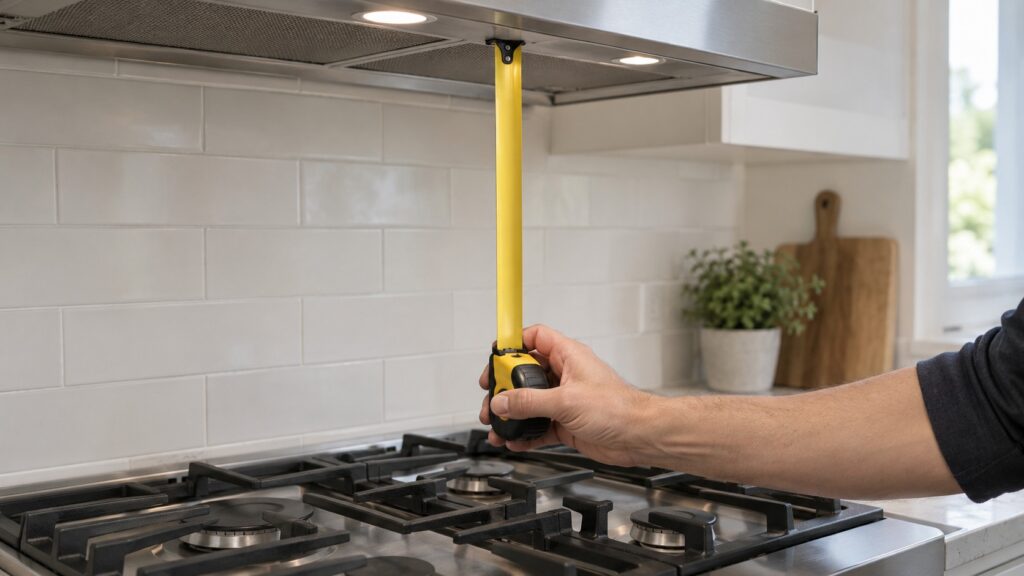
Switch everything off and let the cooktop cool. Pull a tape measure from the top of the grates or the cooking surface, straight up, to the lower edge of the hood. Measure at the front edge of the cooking area and again near the back, because a hood that is slightly out of level will give two different readings. Write the numbers down and compare them with the figure in the installation instructions. If there is a mismatch, do not adjust the hood yourself; a heavy hood on a wall or ceiling mount should be moved by an installer.
If you are planning ahead of delivery, measure the ceiling height and the position of any cabinets, because the allowed range for the hood has to fit the room. Our installation requirements guide has a pre-delivery checklist that includes the hood.
Does hood height depend on the hood or on the range?
Both. The hood’s own instructions give a clearance for that hood, and the range or rangetop you pair it with may add its own requirement, especially with a grill module or other high-heat module. Our hood pages describe the Château hoods in widths of 90, 120, 150 and 180 cm, typically with a four-speed blower and baffle filters; the hood names glossary explains the CornuFé style names. Whichever hood you have, the style name is a design choice and does not change how high it should hang.
What else has to be right at the same time?
Height is only one part of a working hood. The hood should be at least as wide as the range, as our sizing guide says. The duct should be a short, straight run of rigid metal; our pages describe the Château hoods as designed around a 6-inch duct with a blower of about 600 CFM. High-CFM hoods may need make-up air under local code, and your installer can confirm that. Our guide to how the range hood works explains why capture, filtering and exhaust have to match.
What problems point to a hood that is mounted wrong?
Smoke that lingers in the kitchen even with clean filters, grease film on cabinets above the hood, discoloration on the underside of the hood, or heat you can feel on the canopy are all signs worth investigating. Start with the basics in our weak suction guide: clean filters, a clear duct and a free damper. If those are fine and the height is outside the manual’s figure, the fix is a repositioning job for an installer.
What should you do before the hood is hung?
Plan the height together with the range, not afterward. Bring the installation sheets for both the hood and the range to the installer, and ask them to confirm the clearance figure in writing for your exact pairing. If you are remodeling, mark the planned lower edge of the hood on the wall with tape and stand at the range to check that it feels workable, that you will not hit your head on it, and that tall pots clear the front. Changing a mark on a wall costs nothing; moving a hood after the cabinets and ceiling are finished is a bigger job.
Who should adjust the height?
A qualified installer. A hood is heavy, is fixed to the wall or ceiling, and is connected to power and to a duct. Do not open the hood’s electrical compartment, and do not try to lower or raise the hood on your own. If you see water, sparks or smell burning near the hood or its wiring, switch off the breaker at the panel while standing on a dry floor, and never pull a plug from a wet outlet. Our range hood service page explains how a visit works.