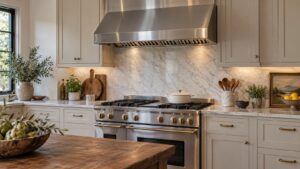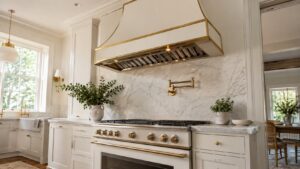
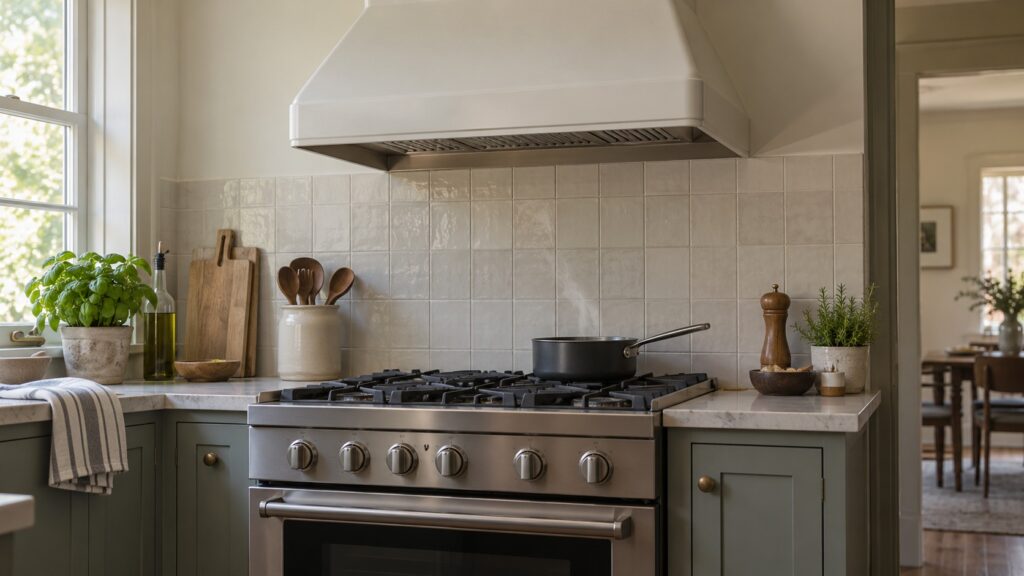
The best La Cornue hood tips are simple: switch the hood on a minute or two before you start cooking, use the lowest speed that keeps the air clear, switch to boost only for searing and frying, cook on the back burners when you can, and let the hood run for ten minutes after you finish. Add clean baffle filters and a way for fresh air to enter the room, and a hood works as it was designed to, instead of just humming above the range.
When should you turn on a La Cornue hood?
Before you light the burners, not after smoke appears. A hood works by creating a current of air that carries steam, grease and smoke up and out. That current takes a moment to establish, and the plume from a hot pan rises faster than a hood that has just started can catch it. Switching on a minute or two earlier means the airflow is already in place when the first splatter hits the pan. It costs you nothing, and it is the single habit that improves capture the most.
Capture also depends on how the hood sits over the range. If you are unsure whether yours is the right size, our guide to sizing a La Cornue range hood explains the rules, and our guide on how the La Cornue range hood works covers the airflow itself.
Which speed should you use?
Match the speed to the cooking. A low speed is enough for simmering, boiling water or warming a sauce. A medium speed suits most everyday cooking. Use the highest speed only for jobs that produce a lot of smoke or grease, such as searing steaks, stir-frying, or frying in oil, and drop it when the heavy part is over. Running a hood on high for every task is noisy and wastes the quiet that makes it pleasant to use, and it pulls a large volume of conditioned air out of the house.
If the hood seems weak even on high, do not assume the speed is the problem. Our guide to a La Cornue hood with weak suction lists the usual causes, from a dirty filter to a blocked duct.
Why do the back burners matter?
A hood captures what rises beneath it, and the area at the back of the cooktop is closest to the hood’s intake. Smoke and steam from the front burners have to travel further and can escape around the edge of the canopy, especially with a shallow hood or a large pan. Put the boiling pot and the searing pan toward the back whenever you can, and keep the front burners for gentle jobs. The effect is easy to see: a pan seared on the front burner fills the kitchen with smoke that the same pan on the back burner does not.
Cover pots when you can, too. A lid reduces the steam and grease the hood must deal with, and it speeds up cooking.
How long should the hood keep running?
Ten minutes after you finish is a good rule of thumb. Cooking odors, fine grease and moisture linger in the air for some time after the burners go off. A hood that runs a little longer clears them before they settle on cabinets, curtains and walls. It matters more on a gas range, which puts moisture and combustion products into the room as well. If your hood has a timer or delay-off feature, use it so you do not have to remember.
What about make-up air?
A hood pushes air out of the house, and the house has to take in the same amount from somewhere. In a modern, tightly sealed home there may be nowhere for it to come from, and the hood then struggles, whistles or draws air down a chimney or a flue. If the hood seems to labor on high, or you hear a whistle at a door, open a window a crack on the side of the kitchen. Larger hoods may need a planned make-up air system, which is a design question; our guide to venting a La Cornue range hood covers the planning.
How do you keep the filters and lights in shape?
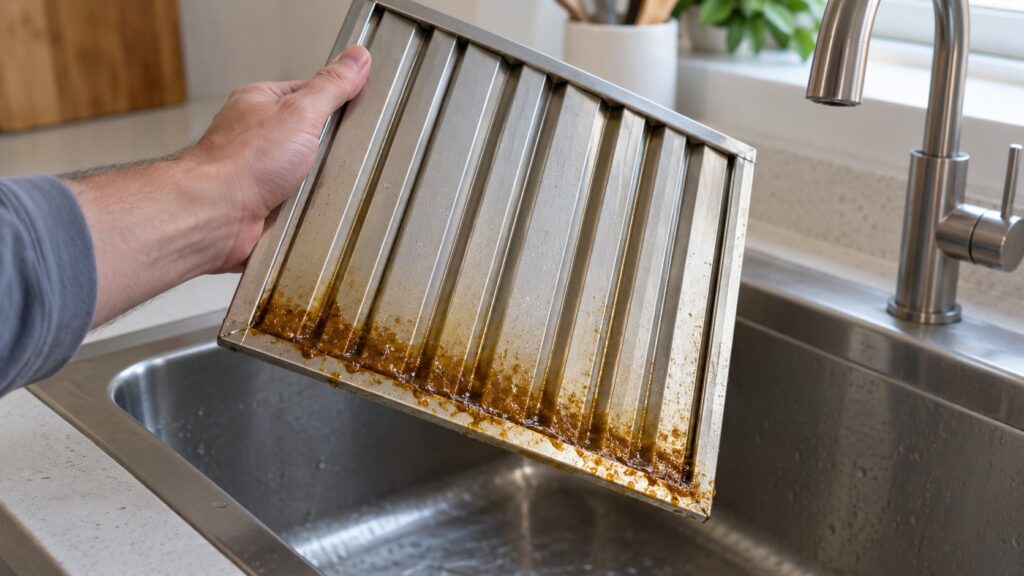
Baffle filters catch grease, and a filter loaded with it slows the airflow and can drip. Wash them about once a month in hot soapy water or in the dishwasher if the manual allows, and wash more often if you fry frequently. Our guide to cleaning La Cornue hood baffle filters shows how. Use the lights when you need them, and switch them off when you do not, since halogen lamps produce heat and burn out; see the guide on replacing hood halogen lights for the safe way to change one.
If you are choosing between hood styles, our Marquee vs Loge comparison and the hood names glossary explain the differences.
What changes with a gas range compared with induction?
A gas range puts combustion products and a good deal of moisture into the kitchen as well as cooking fumes, so the hood has more to do and the after-cooking run time matters more. Induction produces no combustion products, and it heats the pan rather than the air around it, so the hood mostly deals with steam, grease and odor. Either way, the habits above apply, but on gas you should never rely on the hood alone for air quality: crack a window when you cook for a long time and watch for any sign of a gas smell. If the hood is over a dual-fuel range with a gas cooktop and a large oven, check that it is rated for the combined output.