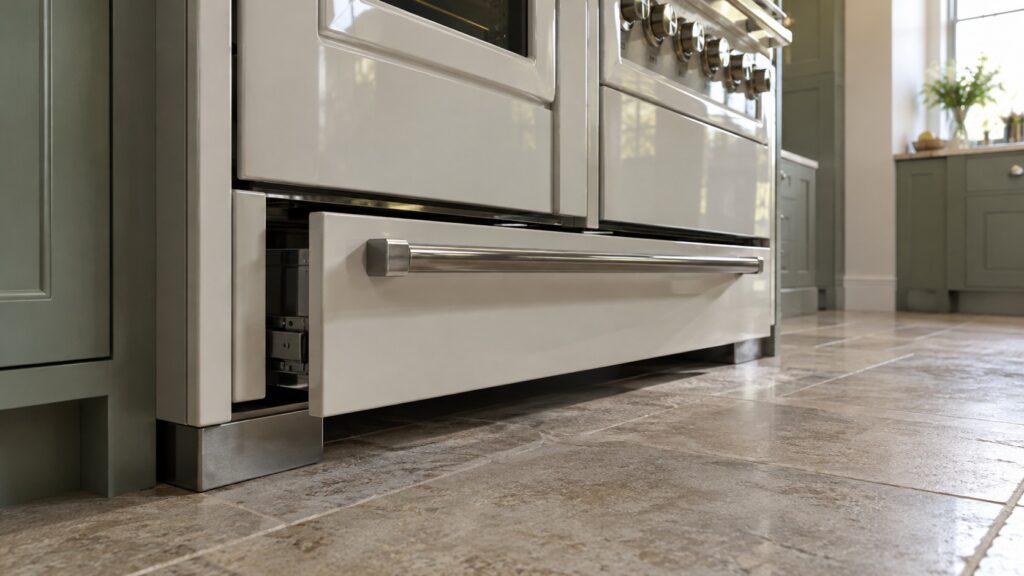
A La Cornue warming drawer not closing flush, jamming partway, or dragging unevenly is almost always a mechanical alignment problem with the slide mechanism or the drawer frame, not a heating fault. The warming drawer sits low on the range’s base, in the position most exposed to items being set down on top of it, spills, and the general knocks of a busy kitchen — which is exactly why its slides and alignment tend to need attention more often than the heating element inside actually fails. Treating a sticking drawer as a mechanical, adjustable problem — rather than as a sign the whole unit is failing — is the right starting mindset for almost every case.
Why does a warming drawer misalign more easily than an oven door or a rangetop component?
The warming drawer sits at the base of the range, which is both the most convenient height for setting down heavy pots or trays and the most exposed position to accidental impacts, spilled liquid running down from the rangetop above, and general wear from being opened and closed daily during meal prep. Its slide mechanism has to support the drawer’s full weight, plus whatever dishes and serveware are loaded inside, across every single opening and closing cycle — small amounts of wear or debris accumulate here faster than on components that see less physical contact and less exposure to spills.
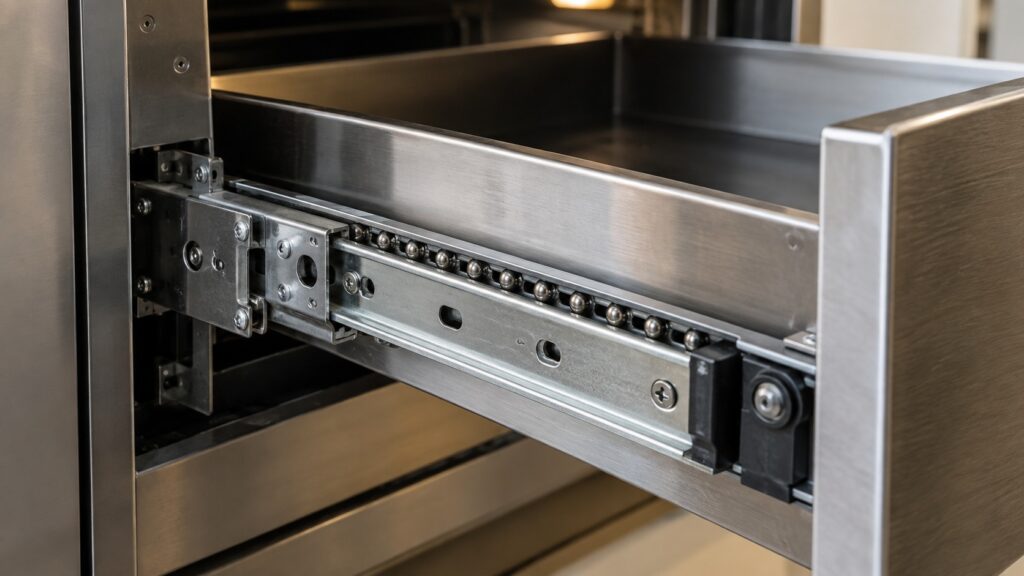
What should you check first if the drawer won’t close flush?
Start by removing everything from inside the drawer and testing how it moves empty — a full load of heavy dishware can mask or worsen a slide problem that would otherwise be obvious with the drawer empty. With the drawer empty, open and close it slowly while watching both sides of the slide mechanism for anything that looks uneven, catches, or drags. Debris in the slide track — crumbs, a dropped utensil, general kitchen grime that has worked its way in over time, or even a stray piece of packaging left behind from installation — is a common and easily fixed cause, and clearing the track often resolves a sticking drawer without any parts needed. A vacuum with a narrow attachment, followed by a wipe with a dry cloth, is usually enough to clear a track without needing to disassemble anything.
What does it mean if the drawer drags on only one side?
A warming drawer runs on two parallel slide mechanisms, one on each side, and they need to move in sync for the drawer to travel smoothly and close flush. If one side drags, catches, or moves more stiffly than the other, that side’s slide is out of alignment or has accumulated more resistance than its counterpart — this is different from a problem affecting both sides equally, which more often points at the drawer frame itself or an obstruction affecting the whole mechanism rather than one slide specifically. Identifying which side is the actual problem, rather than assuming the mechanism as a whole has failed, narrows down what a technician needs to adjust or replace, and it usually means a shorter repair visit since only one side’s hardware needs attention rather than the full mechanism.
Does the drawer’s weight rating matter here?
Yes, and it is easy to overlook because the drawer looks capable of holding far more than the manufacturer intended. Consistently loading heavier cookware, large serving platters, or multiple stacked dishes beyond what the slides were rated for accelerates wear on the mechanism, even if it never causes an obvious problem on any single use. If the drawer developed a drag or misalignment after a period of unusually heavy use — hosting a large gathering with serveware stacked in the drawer for hours, for instance — that pattern is worth mentioning alongside the symptom itself, since it points toward wear from load rather than a sudden manufacturing or installation defect.
Could the issue actually be the range’s leveling instead of the drawer itself?
Yes, and this is worth ruling out before assuming the drawer’s own hardware has failed. A range that has shifted slightly out of level — from a kitchen renovation nearby, a floor settling over time, or simply never having been checked since installation — can make a perfectly healthy drawer mechanism feel like it drags or won’t close flush, because the whole reference frame the slides are working against has tilted. Checking the range’s level with an actual level tool, not just by eye, is a quick step that can rule out this cause before you assume a mechanical part inside the drawer itself is at fault.
It is worth checking level in both directions — front-to-back and side-to-side — since a range can be level in one direction and slightly off in the other, and a warming drawer positioned low on the base is often the first component to reveal a subtle tilt that the rest of the range hides better. If a level check reveals the range has genuinely shifted, adjusting the leveling feet is usually a far simpler fix than anything involving the drawer’s internal hardware.
What should you do if the drawer heats fine but keeps sticking?
- Empty the drawer and test its movement before assuming a serious mechanical failure.
- Inspect and clear the slide tracks on both sides for debris or visible damage.
- Compare how each side moves to identify whether one slide specifically is the problem.
- Check the range’s level with a level tool before concluding the drawer hardware itself has failed.
None of these checks require removing the drawer entirely or opening up the range’s base panel, which is worth knowing before assuming a repair visit will be an involved job. If the drawer is not heating at all, that is a genuinely separate issue from alignment — see our how warming drawers work guide for the heating mechanism itself. Our leveling and anti-tip guide covers checking the range’s level, and our installation-related faults guide covers other symptoms that trace back to leveling rather than a component failure. You can schedule a visit if clearing the tracks and checking level do not resolve the drag.