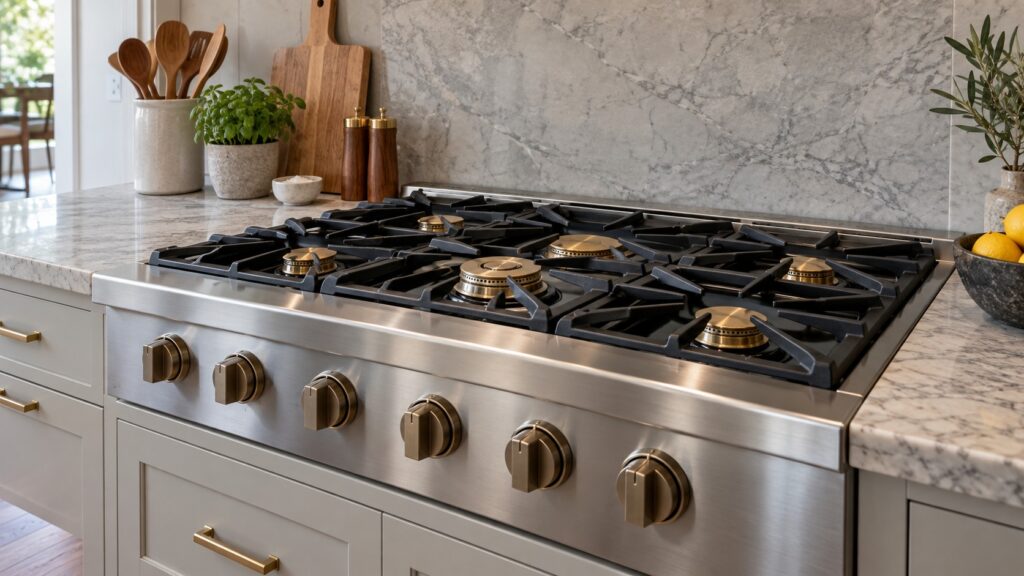
The la cornue cornuchef is the brand’s commercial-leaning professional gas rangetop: a modular cooking surface with high-output brass burners and heavy-duty mechanical valves, built to drop into a counter rather than to stand on the floor as a range. It carries no oven, no enameled body and no legs. It is the piece people mean when they say they want La Cornue cooking without a La Cornue range, and because the name appears on model lists without much explanation, it is worth defining term by term.
What is the La Cornue CornuChef?
It is a professional gas rangetop rather than a range. The distinction is not marketing: a rangetop has knobs on a raised front panel, sits in a counter cut-out with its own cabinet beneath, and leaves the oven to be chosen separately — usually a wall oven at eye level. A range brings its own oven and stands on the floor.
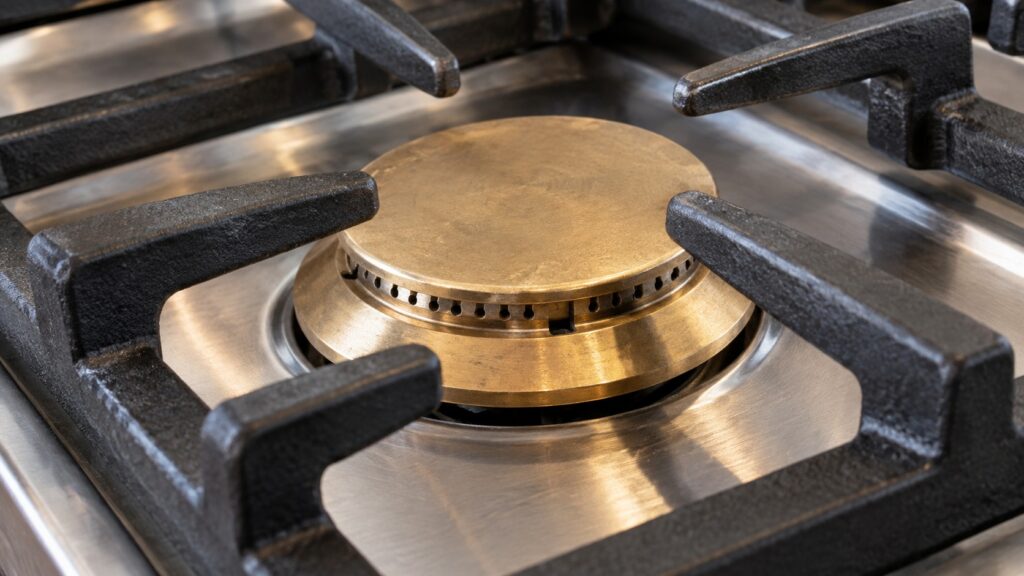
The CornuChef leans toward commercial equipment in the way it is built. The burners are brass and high-output, the valves are heavy mechanical items rather than electronically assisted ones, and the trim is professional stainless and enamel rather than the polished brass and enamel color palette that defines a Château. If you want a definition of the surrounding vocabulary in one place, our La Cornue glossary collects the rest of the terms.
How does a CornuChef differ from a Château rangetop?
Both are rangetops and both sit in a counter, but they are aimed at different kitchens. The Château rangetop is built around the modular idea: you specify which cooking modules go where, and the surface is assembled from them. The CornuChef is built around throughput — the burners are the point, the controls are heavy and simple, and the surface is designed to be wiped down after hard use.
The practical difference shows up in ownership. A Château rangetop owner talks about which module to put in the left bay. A CornuChef owner talks about burner output and how the surface cleans. Neither is better; they answer different questions. Our guide to choosing a rangetop configuration covers the modular decision if that is the one in front of you.
What cooking surfaces can a CornuChef carry?
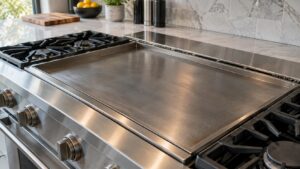
The core surface is brass gas burners at two output levels: high-output front positions for searing and boiling, gentler rear positions for holding and simmering. The optional addition is a French top, the solid plate whose temperature falls off from the center to the rim, letting you park a pan at a low heat by sliding it outward instead of turning a knob down.
A French top rewards a particular way of cooking and frustrates anyone expecting an open flame, so it is worth understanding before specifying one. Our pages on how the French top works and how to cook on one describe the behavior in full.
What does a CornuChef need from the kitchen around it?
Three things, all of which have to be settled before delivery rather than after. It needs a counter cut-out and a supporting cabinet built to the model’s dimensions, because a rangetop is carried by the counter and not by legs. It needs a gas supply sized for the total output of the burners, which on a professional top is considerably more than a standard residential range draws. And it needs ventilation matched to that output, which in practice means a hood wider than the top with a blower rated for the burners beneath it.
The gas type has to be settled at the same time. The CornuChef is supplied for natural gas with an LP conversion available, and that conversion is an orifice job for a qualified technician rather than an adjustment. Our pages on rangetop installation and on natural gas to propane conversion cover both.
What goes wrong on a CornuChef, and can it be repaired?
Mechanical simplicity is the whole story here. With no electronic control in the gas path, the faults are the classic ones: a spark module that clicks continuously, a burner that will not light because a cap or an electrode is out of place, a knob that has become stiff because the valve grease has hardened, a knob loose on its shaft, or yellow flames that point at an air-mix problem or at the wrong gas type. All of them are repairable in place, and none of them requires replacing the top.
The two that should stop you are a gas smell and a valve that leaks or binds. Both sit on the gas side, both are line-pressure work, and neither should be tackled with household tools. Everything else on a CornuChef is a matter of cleaning, reseating and adjustment before it is a matter of parts.
Who should be looking at a CornuChef at all?
Kitchens where the oven is already solved, and cooks who want output more than they want a showpiece. If you have wall ovens you like, a CornuChef gives you La Cornue burners without buying an oven twice. If you want the enameled body, the brass trim and the vaulted oven, you want a range and not a rangetop.
We are an independent repair company covering La Cornue equipment in all 50 states, not a factory service arm, and we will tell you when a repair is not worth doing. Pricing starts from a diagnostic visit, from $149 in most areas, and we confirm the estimate before any work begins. For a burner, a valve or an ignition fault, our La Cornue rangetop repair service covers the CornuChef, and you can call 1-844-579-1439 or schedule a visit online.