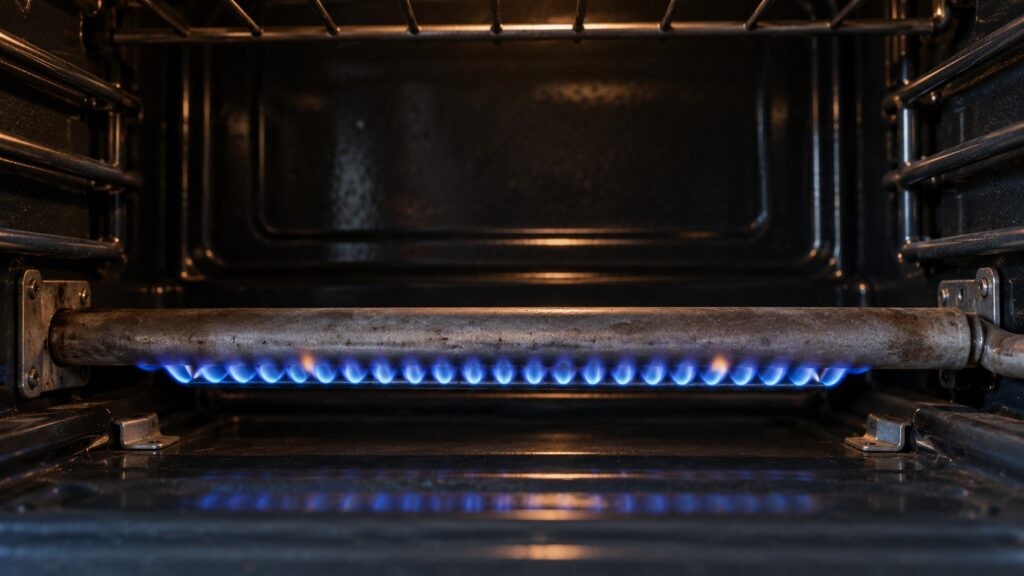
How a La Cornue oven igniter and safety valve work is a short chain of events: the control calls for heat, the igniter warms up, the igniter’s rising current opens the gas safety valve once it is hot enough to light the gas, the burner ignites, and the oven holds its temperature by cycling that same sequence. If any link is weak, the oven either never lights or lights and then shuts off, which is why a glowing igniter and a cold oven are such a common pair.
What does the oven igniter actually do?
In many gas ovens the igniter is a ceramic bar that glows when electricity passes through it. It plays two roles. First, it gets hot enough to ignite gas, typically glowing orange or white. Second, it acts as a switch: as it heats, its electrical resistance changes, and the current through it rises. That rising current is what the safety valve waits for. A healthy igniter reaches the needed current within a short time, the valve opens and the burner lights. An igniter that is weakening still glows, but it may never draw enough current to open the valve, so the oven sits there with a glow and no flame.
Because the igniter is the part that gets hottest and cycles most often, it is also one of the most commonly replaced oven parts. Our guide to a La Cornue oven not heating because of the gas igniter explains the symptoms in detail, and our decision guide on repairing or replacing a vaulted oven igniter helps you plan the fix.
How does the safety valve protect you?
The safety valve sits in the gas line to the oven burner and is normally closed. It opens only when its small coil is powered by the igniter circuit, and it stays open only while that circuit carries enough current. If the igniter fails, if the power drops, or if the flame goes out and the sensing circuit changes, the valve closes and gas stops. That behavior keeps unburned gas from filling the oven when something goes wrong. The valve is sometimes called a safety valve, a gas valve or an oven valve, and the names are used loosely.
It is not a part to adjust, test with a flame or bypass. Any work on the gas side belongs to a qualified technician. If you ever smell gas, do not light anything, leave the area and follow the steps in our gas smell safety guide.
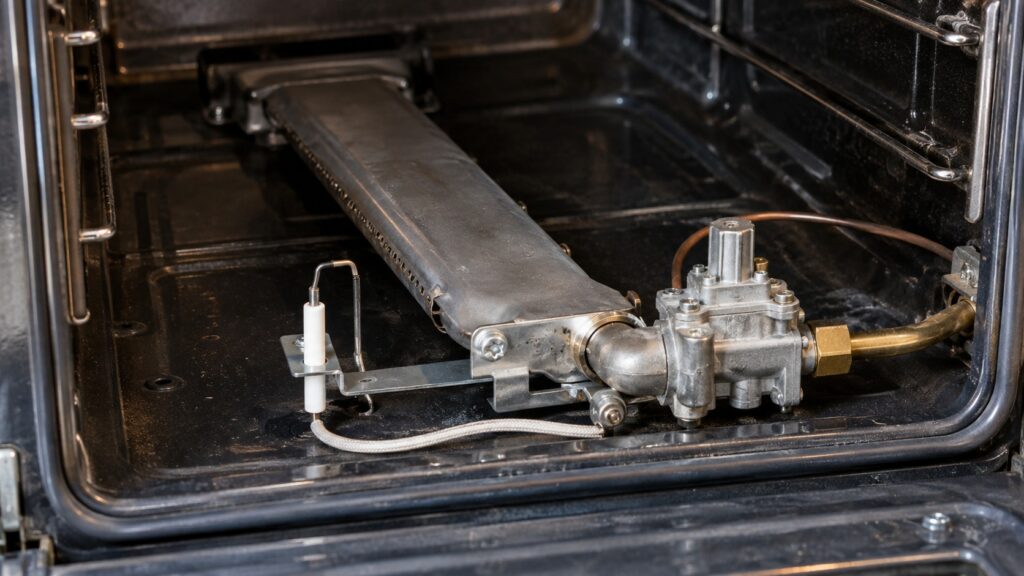
What is the difference between an igniter oven and a pilot oven?
A pilot oven keeps a small flame burning all the time, and the burner lights from that flame when called. A pilot adds a small, steady gas use and needs a sensor, usually a thermocouple, to prove the pilot is lit. An igniter oven lights only when needed and uses no gas while it rests. Both designs rely on a safety device that shuts off the gas if the ignition source is lost. The symptom lists on our site cover both, including ovens whose pilot will not stay lit. Which design you have depends on the model and the production year, so check the manual.
How does the oven hold its temperature?
Once the burner is lit, the thermostat or the electronic control watches the cavity temperature. When the temperature reaches the set value, the control cuts power to the valve, the valve closes and the burner goes out. When the temperature falls, the control starts the cycle again, igniter first. Each cycle depends on the full chain working, so an oven that cannot complete the chain will show a drift or a failure to reach temperature. If the oven reaches the set point and then overshoots or falls short, calibration may be the issue, and our guide to oven temperature drift and calibration explains it.
Does the fuel type change the process?
The logic is the same on natural gas and propane, but the orifice and the regulator differ, which is why a conversion needs the proper kit and a correct setup. A range converted without the right parts can light with a weak or yellow flame, or not light at all. Our guide to converting a La Cornue from natural gas to propane covers the process. On a dual-fuel range the oven is gas and the cooktop may be gas as well, while an induction version has an electric oven, so check which type you own. Our guide to how a dual-fuel La Cornue range works shows the split.
What problems does this chain cause?
- Clicking or glowing with no flame: a weak igniter or a valve that will not open.
- Flame that lights, then dies: a sensing problem or a valve that closes early.
- Long delay before the flame appears: an aging igniter that takes longer to reach full current.
- Weak flame or poor heat: a pressure, orifice or conversion problem.
Some apparent ignition faults are caused by installation, such as low gas pressure or a poorly sized line. Our guide on faults that are installation problems helps to separate them. For an oven that will not light, see the oven repair page.