The La Cornue control board repair or replace question has a clear answer in most cases: repair first. A lockout, a dead display or a stuck relay is often a loose connector, a failed sensor or a single bad component that a technician can trace, and a new board is only the right call when testing shows the board itself has failed, or when the board for an older range can no longer be sourced and a repair is no longer practical.
What does the control board do on a La Cornue oven?
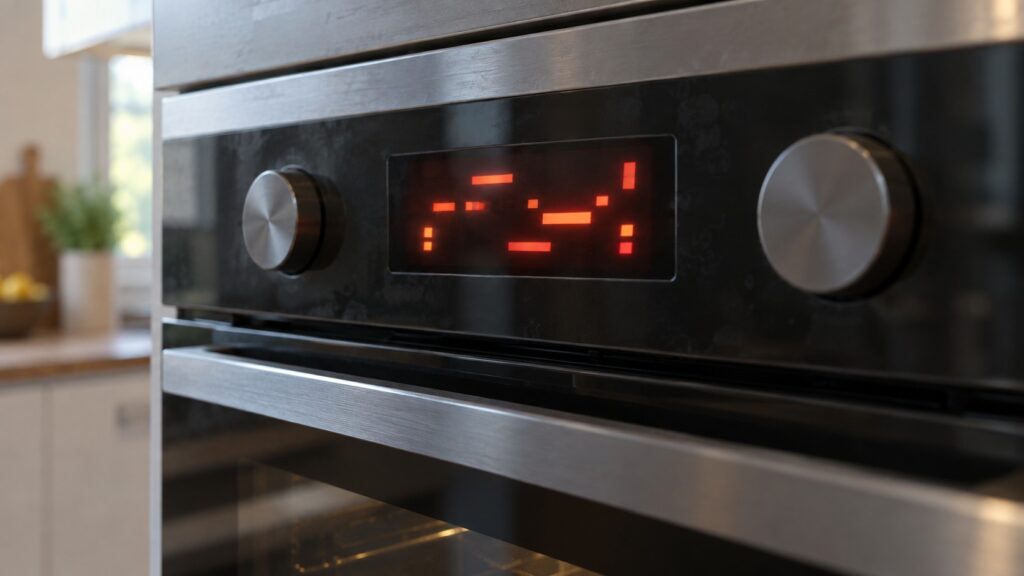
The control board reads your settings on the dials and the display, reads the temperature sensors in the oven, and switches the heat sources, the fans, the lights and the safety circuits accordingly. On a dual-fuel or induction range it also manages more complex tasks, such as the induction zones and the communication between the cooktop and the oven. When the board misbehaves, the symptoms are strange and varied: a display that shows an error, a lockout that will not release, an oven that shuts off at random, zones that flash and a clock that resets itself.
Because so many different faults can look like a board failure, the board is the most frequently misjudged part on a modern range. A sensor that reads wrong, a loose connector or a damaged wire can reproduce nearly every one of these symptoms. Our guides to the oven control board lockout and the Er oven error explain the common patterns.
Which board problems are worth repairing?
If the board is sound and the problem is around it, a repair is the sensible path. Connectors can loosen with heat cycles and vibration, and a reseated or replaced connector may restore the function. A relay on the board can fail while the rest of the circuit remains healthy, and a technician with the right skills can sometimes replace it. A single cracked solder joint is another classic fault. Power-supply problems upstream of the board, such as a failing breaker, a loose neutral or a poor ground, can also cause strange behavior, and fixing them costs far less than replacing the board.
A connection error on an induction range is a good example. It can result from wiring or installation, not from the board, as our guide to the U400 connection error and the guide to induction wiring explain.
When does the board itself need replacing?
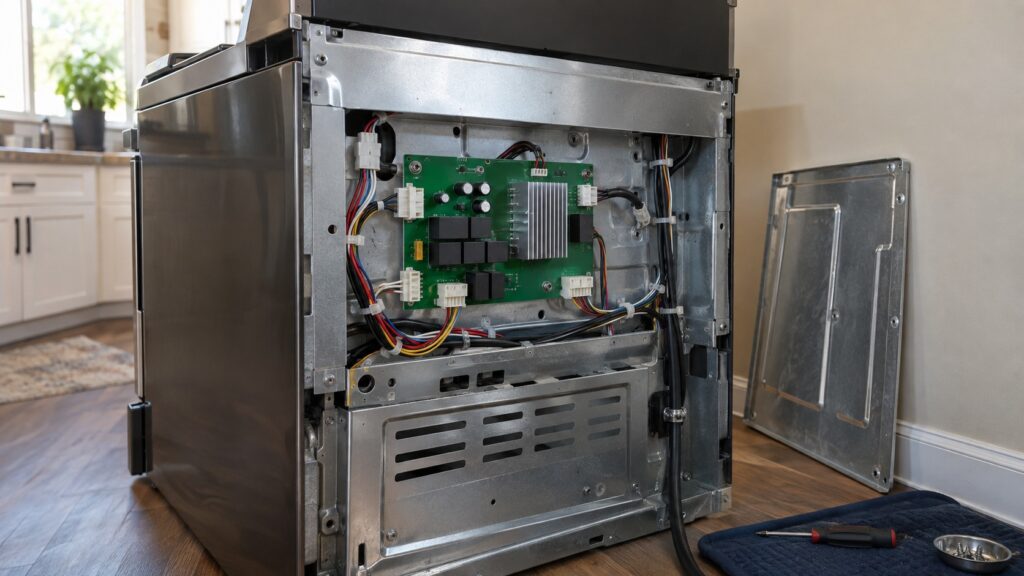
A board is a candidate for replacement when testing shows that it no longer produces the outputs it should, when it has burn marks, swollen capacitors or water damage, or when a power surge has knocked out several functions at once. The replacement should match the model and the revision, because boards for different versions of the same range are not always interchangeable. A technician will usually test the sensors, the wiring and the supply before condemning the board, since a new board connected to the same fault would fail in the same way.
On an older range, sourcing the correct board can be a challenge. Check whether the part is available before you commit to a diagnostic path, and ask about lead times. If the board is no longer available or the lead time is long, the decision moves toward other options, which may include an alternative control arrangement or, in the end, replacing the range.
How should you weigh the decision?
- Ask for a diagnosis that tests the sensors, wiring and supply before the board.
- Ask whether the part is in stock and what the warranty on the repair is.
- Consider the age and condition of the range as a whole, not just the board.
- Compare the repair with the value of the range, which for a La Cornue is considerable.
A La Cornue holds its value and its place in the kitchen, so replacement is rarely the first answer. For the broader question of value, read our guide on whether a La Cornue range is worth it, and for a related decision on a component of the oven, the guide on repair or replace a hi-limit thermostat uses the same reasoning.
What can you do before calling?
Turn the range off at the breaker for a few minutes and restore power. A brief power cycle clears some software faults and resets a lockout. Note what the display showed, when the fault began and whether it follows a power cut, a storm or a spill near the controls. Do not open the control panel yourself; it contains mains voltage. Write down the model number and the exact symptom, and have them ready when you schedule a visit. You can also read about our oven repair service.
What can you do to protect the board?
Most boards fail because of heat, moisture or electrical stress. Keep liquids away from the control panel and wipe spills at once, and never spray cleaner onto the controls. Make sure the range has the circuit the installation sheet requires, with a solid ground, and consider a surge protector rated for the load if your power is unreliable. Keep the area behind and around the range free of grease and dust, since heat is the quiet enemy of electronics. If the kitchen floods or a pipe leaks nearby, have the range checked before you use it again, because moisture can damage a board long after the water is gone.