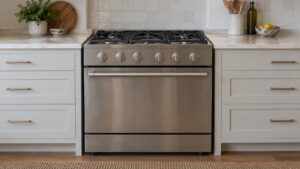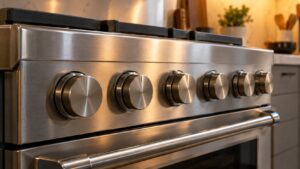
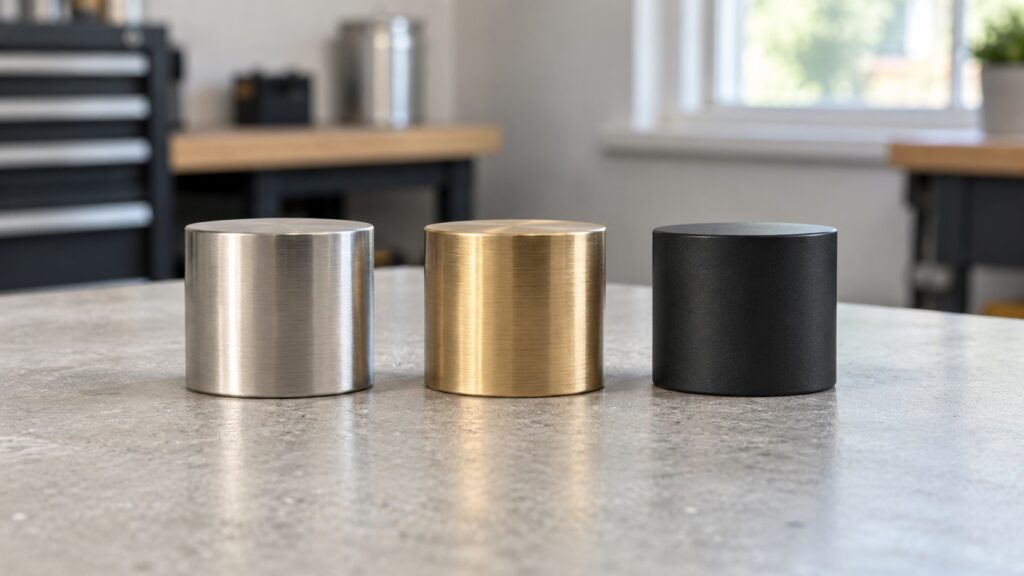
La Cornue brushed nickel polished brass matte black are the three trim finishes named on many of our Château model pages, alongside chrome, copper, bronze and stainless on others. Polished means mirror-bright and shows fingerprints. Brushed means a satin texture with fine lines that hides marks. Matte black is a flat, non-reflective finish. Brass develops a patina over time, as our brass guide explains. This glossary explains the words you will meet on a spec sheet and what each one means for care.
What do polished and brushed mean?
These words describe the surface of the metal, not the metal itself. Polished metal has been buffed to a mirror shine, so it reflects the room, and it shows every fingerprint and water spot. Brushed metal has been drawn along one direction with an abrasive, leaving a fine, uniform grain and a satin look. Our brass cleaning and polishing guide says polished brass shows tarnish and fingerprints more readily, while brushed brass hides marks better. The same holds for nickel. The finish names only describe how the metal looks today; your order sheet says what your trim actually is.
What is matte black?
Matte black appears on our Château model pages, for example the Château 165, 150, 120, 90 and 75 variants, next to brushed nickel and polished brass. It is a flat, dark finish that does not shine. We do not describe how it is applied or what it is made of, because our site does not say, so check your documents for care guidance. As a general rule for any dark matte surface, avoid abrasive pads and polish, which can leave shiny patches, and wipe with a soft damp cloth. If the manual specifies a cleaner, use that one.
What is a patina, and why does brass develop one?
Patina is the natural darkening and color change that brass develops as it reacts with air, moisture and heat. Our brass guide says brass naturally tarnishes and develops a patina, and that you can either maintain a bright shine or let the patina develop, because both are legitimate. On a burner cap, darkening from heat is normal wear, not damage, per our burner caps and grates care guide. Trying to polish it back is how owners thin the finish. Nickel and chrome trim have their own care: our trim care guide says to avoid abrasives, bleach, acids and ammonia.
What is the difference between raw and lacquered brass?
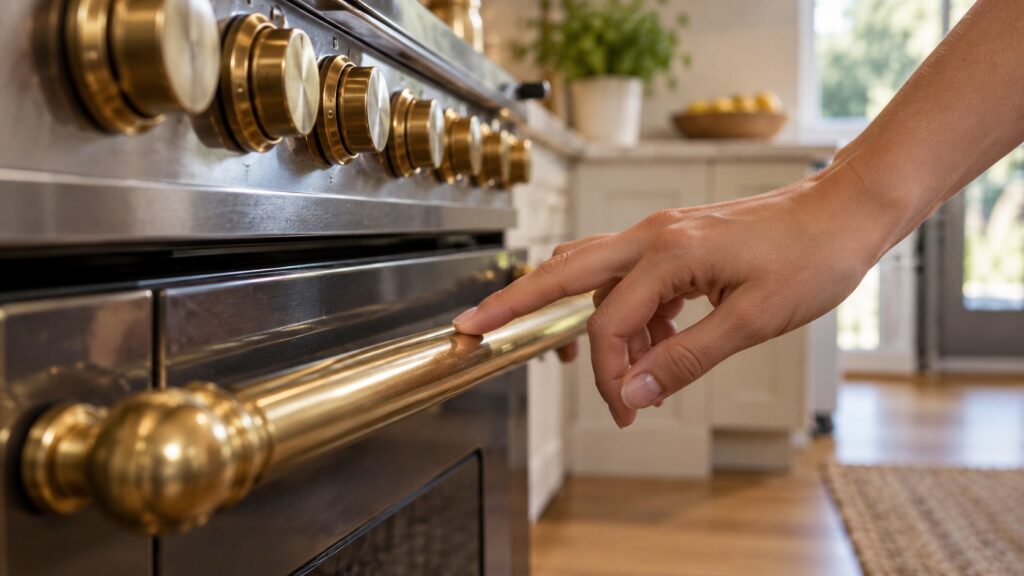
Raw brass has no coating, so it tarnishes and can be polished to restore shine. Lacquered brass has a clear protective coating that keeps it bright but must not be polished with abrasive products, because that scratches through the lacquer and ruins the finish unevenly. If you are not sure which you have, our guide says to test a hidden spot or ask our service line, rather than guessing. Many finish problems come from using brass polish on lacquered metal.
What are plating and black chrome?
Plating is a thin layer of metal laid over another metal. Nickel and chrome trim are often plated finishes, which is one reason abrasives and harsh chemicals can damage them. Our nickel and chrome trim care guide mentions polished and brushed nickel as well as polished and black chrome, and says black chrome shows every dust speck and smudge, so a quick, gentle wipe beats an occasional hard scrub. Avoid scouring pads, steel wool, bleach, acids and ammonia, and spray cleaner onto the cloth, not onto the trim or near knobs.
How does enamel relate to metal trim?
The painted look of a La Cornue comes from enamel, which our enamel care guide describes as glass fused to steel. It is a different material from the metal trim, with its own care: warm water, mild soap and no abrasives. Our model pages list about 50 enamel colors on the Château, plus the Suzanne Kasler and Étoilé collections, and our guide to choosing enamel colors and trim explains how colors and finishes are meant to work together. Keep trim care and enamel care consistent so the whole range ages evenly.
How do you choose a finish, and where does each appear?
Think about how you live in the kitchen. A polished finish is striking and will need frequent, gentle wiping; fingerprints on polished brass or nickel show up the moment someone touches a handle. A brushed finish forgives daily use and is the practical choice for a busy household. Matte black is bold and modern and suits a kitchen with strong contrast, but it shows dust and any shiny scuff from a wrong cleaner. Brass adds warmth and will change over time, which some owners love and others do not; decide before you order whether you want to polish it or let it age. Ask your dealer for a sample or visit a showroom, because a finish looks different under your own kitchen lighting than in a catalog.
The finish is a cosmetic choice and we make no claim that it changes how the range cooks. What it does change is the care routine. Keep a soft microfiber cloth for each finish, wipe along the grain on brushed metal, and dry after wet cleaning to prevent water spots. Our knob and bezel care guide covers the parts you touch most.
On the Château, the finish choices appear on the handles, knobs, rails, bezels and other trim, and on the burner caps and bases, which are brass on many models. Our Château 165, 150, 120, 90, 75 and 60 pages list variants in matte black, brushed nickel and polished brass, with a few also in the Suzanne Kasler collection. The widest list we publish, on the Le Château 120 page, covers polished or brushed brass, nickel, chrome or copper, matte black or bronze and stainless. Your own order sheet is the final word on which finish you have, and on whether your brass is raw or lacquered.