
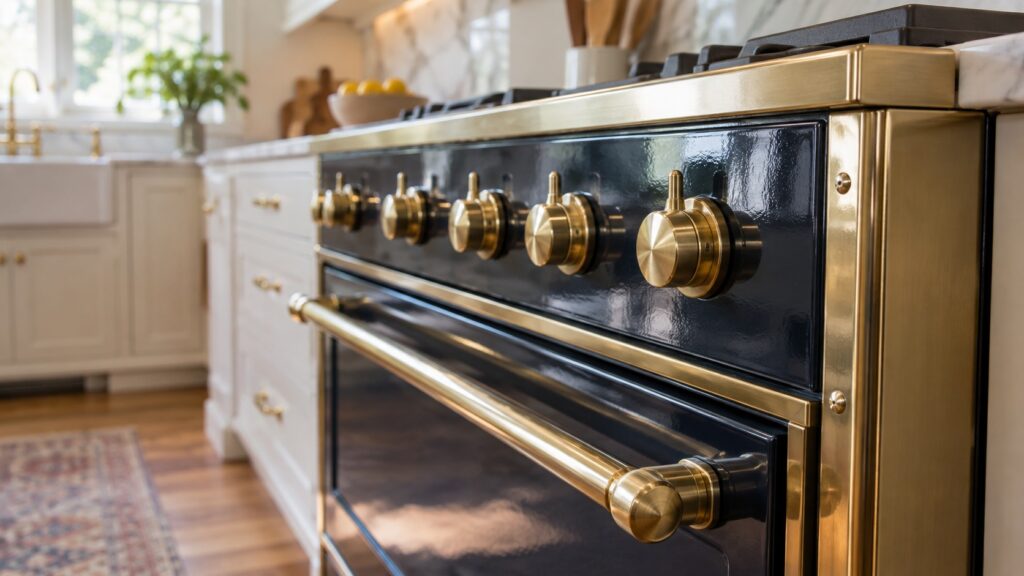
The enamel on a La Cornue range is not paint and it is not a coating in the ordinary sense. It is glass, fused to steel at high temperature, and it behaves like glass: hard, chemically stable, indifferent to heat, and vulnerable to exactly one thing — impact. Almost all la cornue enamel care comes down to understanding that single fact, because it explains both why these surfaces survive decades and why the damage they do take is permanent.
Why abrasives are the one unforgivable mistake
Enamel is glass with a polished surface, and gloss is a surface property. Scratch it and you have not removed a layer of dirt, you have permanently dulled an area that will now hold grease and look different from everything around it under every light in the room. Nothing restores it.
This is why a scouring pad is worse than leaving the mark alone for a week. A baked-on spot will come off eventually with patience and warm water; a scoured patch is there for the life of the range. The same applies to powdered cleansers, magic-eraser sponges and anything sold for cleaning ceramic cooktops — all of them are abrasive by design.
What chemistry does to it
Enamel resists almost everything, with two exceptions that matter in a kitchen. Strong alkalis — oven cleaner, drain cleaner, some degreasers — etch it dull over repeated contact. Strong acids left to sit do the same: lemon juice, vinegar and tomato are harmless wiped away and are not harmless dried on overnight and reheated.
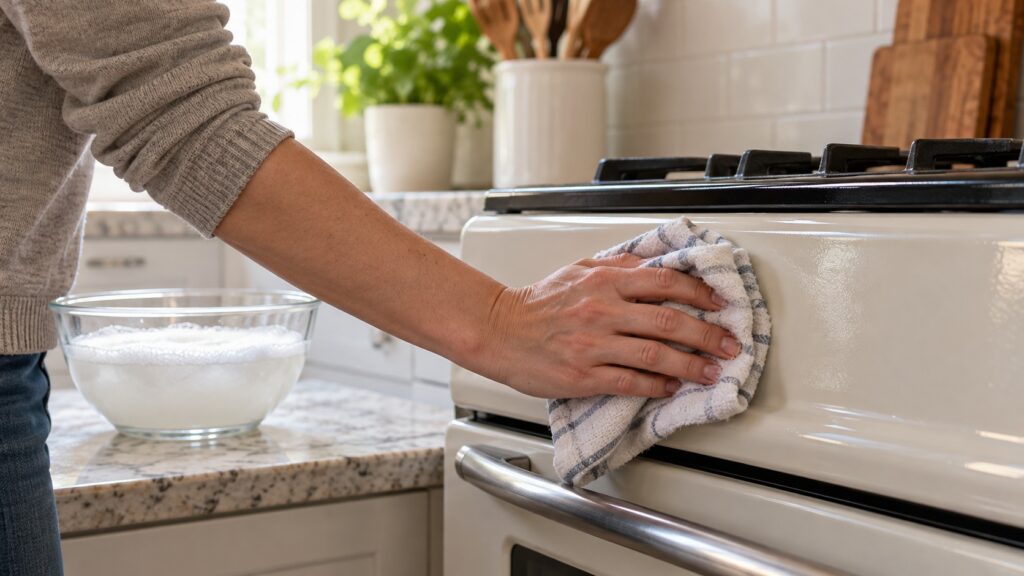
The practical rule is boring and effective: nothing on the enamel except warm water and a mild dish soap, and no chemical left in contact for more than a few minutes. If a proprietary cleaner is used anywhere on the range, it goes on a cloth and never sprayed, because overspray lands on the enamel you were not cleaning.
Chips: what to do, and what not to
A chip is the failure mode that matters, because it exposes the steel underneath. Steel that is exposed will oxidize, and rust creeping under the enamel edge lifts more enamel over the years. The chip itself is cosmetic on day one and structural on year five.
- Keep it dry and clean. Rust needs moisture. A chip wiped dry after every clean will sit unchanged for a long time.
- Touch-up enamel exists and is a cosmetic seal, not a repair. It stops moisture reaching the steel, which is the point.
- Do not sand around a chip. Sanding spreads the damage into sound enamel.
- Heavy pans are the usual cause. A cast iron pot set down hard on a door edge is the classic. Lift rather than slide.
Brass and trim live by different rules
Most of what surrounds the enamel is not enamel. Brass trim, stainless rails and knob bezels each want their own treatment, and the mistake is using one product across the whole range. Brass wants a dry cloth and, occasionally, a polish made for it — and the polish must not be allowed onto the enamel beside it. Stainless wants wiping with the grain. Our knob and bezel care guide covers those, and the stainless surface guide covers the cooking top.
Where two materials meet — brass against enamel, a stainless rail on an enameled door — is where residue collects and where careless cleaning does its damage. Work along the joint with a soft cloth rather than across it with anything stiff.
Heat, thermal shock and the crazing question
Enamel handles heat without difficulty; what it dislikes is sudden change. Cold water onto a hot enameled surface is thermal shock, and while a single incident rarely does visible harm, it is worth avoiding as a habit. Let a surface come down to warm before cleaning it.
Fine crazing — a network of hairline lines in the gloss — appears on some older enameled appliances and is age rather than misuse. It is cosmetic and it does not expose the steel. It does, however, hold staining more readily, so a crazed area benefits from being wiped more often rather than cleaned harder.
The colored finishes and what they ask for
La Cornue’s colors are in the enamel rather than on it, so a colored range is not more fragile than a black one and cannot fade in the way paint does. What differs is how visible damage is: a chip on a dark color shows the pale steel starkly, and a dull scoured patch reads more strongly on a saturated color than on a neutral.
That argues for more care rather than different care. If you are still choosing, our guide to colors and trim covers the options.
The routine that actually keeps it looking new
Everything above reduces to a short habit. Wipe spills while the surface is still warm, because warm enamel releases what is on it and cold enamel does not. Use the softest thing that works and escalate only by patience, never by abrasion. Dry the surface afterwards, so nothing dries in streaks and no moisture sits at a chip. And keep the cleaning products for the rest of the kitchen away from the range entirely — most damage we see arrived as overspray from something aimed at a counter.
Done that way, an enameled range front looks the same at twenty years as at two. That is not marketing; it is the property of glass, and it is the reason the material was chosen in the first place.
When to call
Enamel damage is not usually a service call — it is a cosmetic matter and, where the panel is replaceable, a parts question. What is worth a visit is rust that has begun to lift enamel around a chip, a door panel whose enamel is failing along a heated edge, or any damage that has left a sharp edge where hands go.
We are an independent repair company, not a factory service arm. Pricing starts from a diagnostic visit and we confirm the estimate before any work begins. La Cornue range repair covers the range as a whole, and you can schedule a visit online. For the oven door specifically, the gasket care guide is the companion to this one.