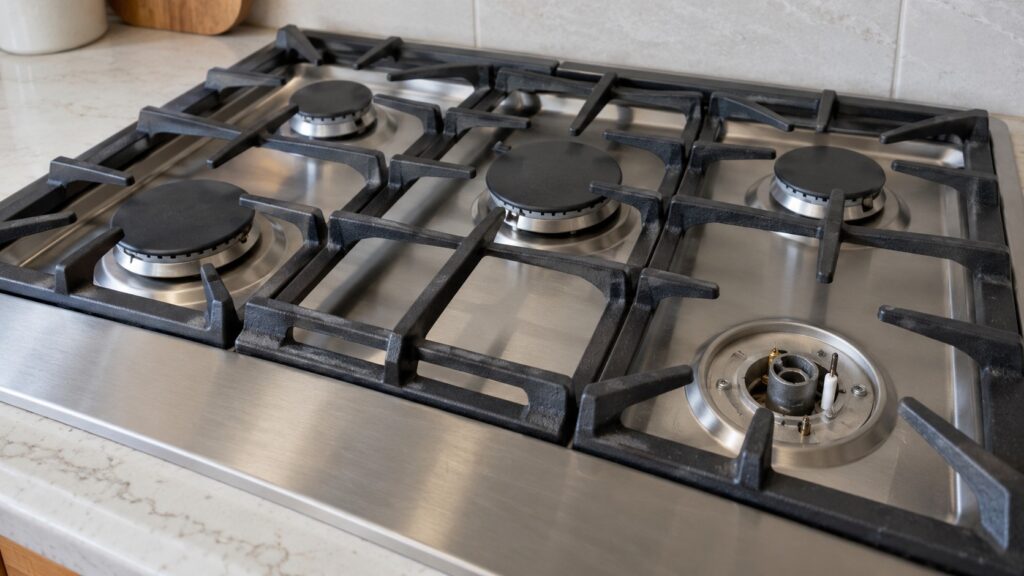
Is a La Cornue rangetop burner worth fixing? Almost always, yes. Our model page describes the Château gas burner rangetop as a module with brass flammes gas burners, and a burner is built from parts that can be replaced one by one: the cap, the crown, the igniter and the valve. Cap and crown wear is a simple part swap. A burner that clicks but will not light is often moisture or a cap that is not seated flat. An igniter or valve problem needs a technician. Replacing the whole module is rarely the answer. This guide sorts the faults and says where the owner stops and the technician starts.
Which burner problems are worth repairing?
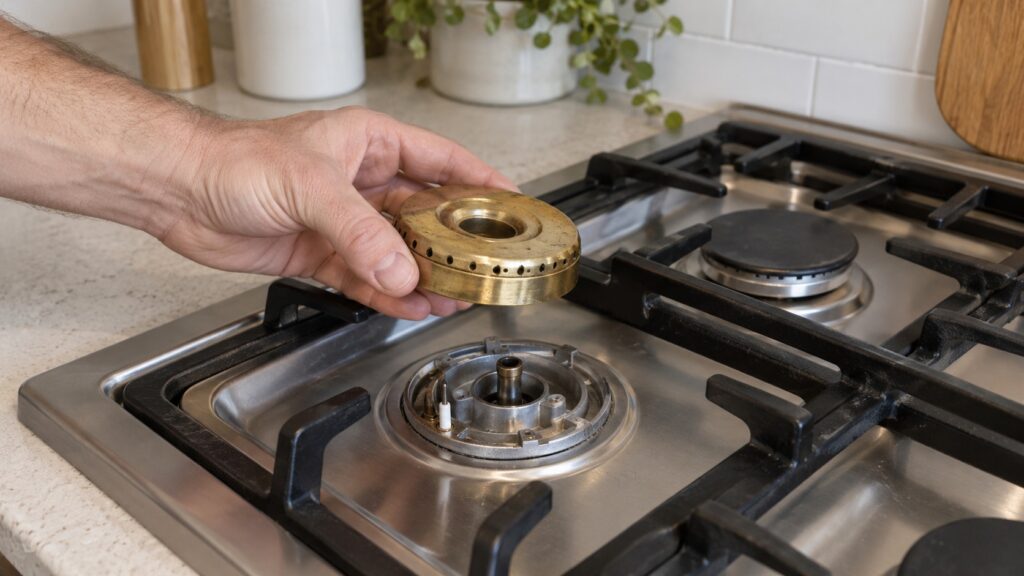
All the common ones. A worn or corroded cap or crown is the simplest: our burner caps and grates care guide says a cap is finished when its rim is eaten away, when a port has been enlarged and that flame never looks like its neighbors again, or when enamel has chipped through to the metal. These are replaceable parts, and replacing one is a simpler fix than living with a burner that never lights cleanly. A burner that clicks without lighting is next: dry the parts, reseat the cap and, with the burner cold and the cap off, clear the ports with a wooden toothpick only, as our clicking igniter guide explains. If that does not help, the igniter or spark module is a modest repair for a technician.
A yellow or weak flame points to blocked ports or an air-mix problem; see our yellow flame guide. Cleaning comes first, and a technician second.
What about the gas valve and the knob?
These are the parts you do not touch. A stiff knob can be a sign of a valve that needs service, and a valve that leaks is a safety problem. Our stuck burner knob guide explains the checks that are safe, and our gas valve replacement guide explains that valve work belongs to a licensed technician. If you smell gas, do not light anything or touch a switch; leave the home and call the gas utility or 911 from outside. Never test a valve for leaks with a flame, and never adjust a valve or regulator yourself.
When is a burner past saving?
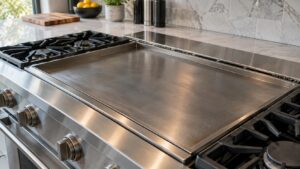
A burner is rarely past saving as a whole, because the parts are separate. What can be past saving is a particular part: a cap with a chewed-up rim, a crown with damaged ports, an electrode that is cracked, or a valve that no longer holds. The decision is usually a part replacement, not a whole new rangetop. If more than one burner has serious problems and the range is old, a technician can tell you whether repair across the whole rangetop makes sense or whether you should think about a bigger change. Our rangetop configuration guide explains how people choose burners, a French top, a grill and a teppanyaki plate for their cooking.
How do you decide, step by step?
First, clean and dry the cap, crown and ports, and reseat the cap flat. If the flame is fine afterward, you have saved a visit. Second, if one burner has a problem and the others are fine, the fault is local, and a local part, cap, crown, igniter or valve, is the likely answer. Third, if every burner has the same problem, the cause is probably shared, such as the gas supply, a regulator, the spark module or moisture; that is a technician’s call. Fourth, ask for a clear estimate that names the part before you agree. We do not quote prices here, and our cost to repair guide explains how to think about them.
What should you tell the technician before the visit?
Describe the burner clearly, because it saves time and parts. Say which burner it is, front or rear and left or right, and whether the problem is on that burner only or on all of them. Say what it does: no spark, a spark with no flame, a flame that is yellow, small or uneven, a flame that goes out, a knob that is stiff, or a smell of gas. Say when it started, and whether it followed a deep clean, a boil-over or a move of the range. Tell us whether you have cleaned and dried the cap and ports, and whether you changed anything. If you have the model name from your paperwork, have it ready; our model name guide explains how to read it. A short phone video of the burner clicking and the flame is very useful.
It also helps to know that burner parts are identified by position and style, so a photo of the cap and crown with the grate removed lets the technician bring the right part. If a part has to be ordered, ask for the expected wait, and keep the other burners available in the meantime. Avoid a repair that mixes parts from other models; a cap that is the wrong size sits proud and gives a poor flame.
What should you never do?
Do not use a burner that you suspect leaks. Do not defeat a safety device, and do not poke at a port with metal. Do not run a burner with a cap missing or with a cap that rocks. Do not take off the burner base or the control panel to look for the fault. If a burner is damaged and you must keep cooking, use another burner and mark the damaged one off until it is fixed. If you see sparks or smell burning near the spark module or the controls, switch off the breaker at the panel while standing on a dry floor.