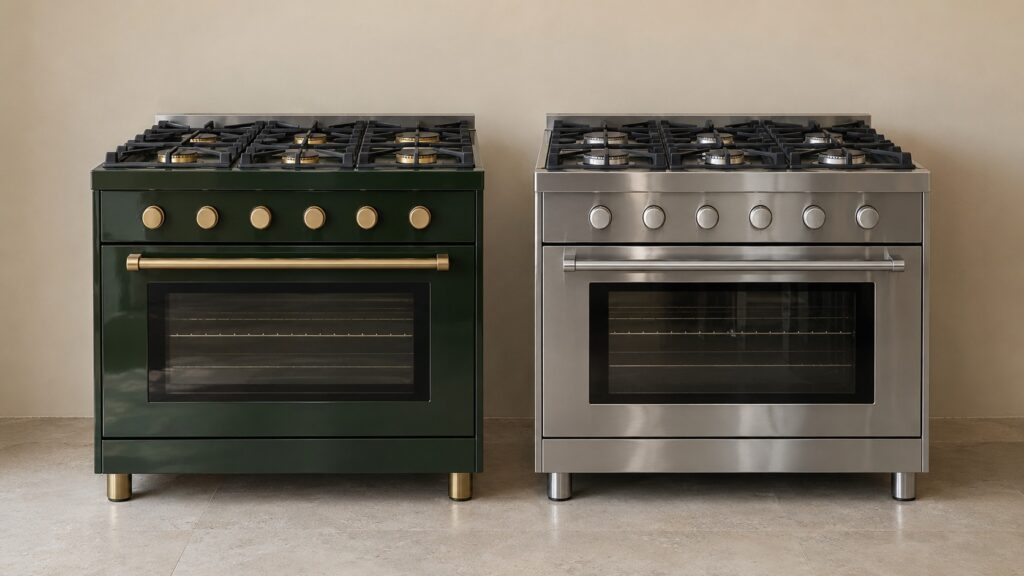
La Cornue vs Viking range is a comparison between two very different ways of buying a premium range: a hand-built, made-to-order French range with a vaulted oven on one side, and a US professional-style range line on the other. We service La Cornue, not Viking, and we are an independent repair company, so we will not say which is better, rate either brand or quote prices. What we can do is lay out the decisions that separate any two premium ranges, answer the La Cornue side from our own model pages and leave the Viking side as questions for you to check on Viking’s current spec sheets.
How should you compare La Cornue and Viking ranges fairly?
Compare them on the same list of questions, not on reputation. Write down what you cook and bake, the width you have, the fuels available in your kitchen, how soon you need delivery and how much customization matters, then answer each question from each maker’s own documentation. A range that suits a hobby baker with a deep appetite for custom color is not the same range as one for a busy family that wants a quick delivery, and neither answer makes the other brand worse.
The sections below cover the questions in the order most buyers find decisive. Everything said about La Cornue comes from our own model pages and guides. For Viking, we point you to its current published specifications instead of repeating claims we cannot verify here.
How are the ovens different in design?
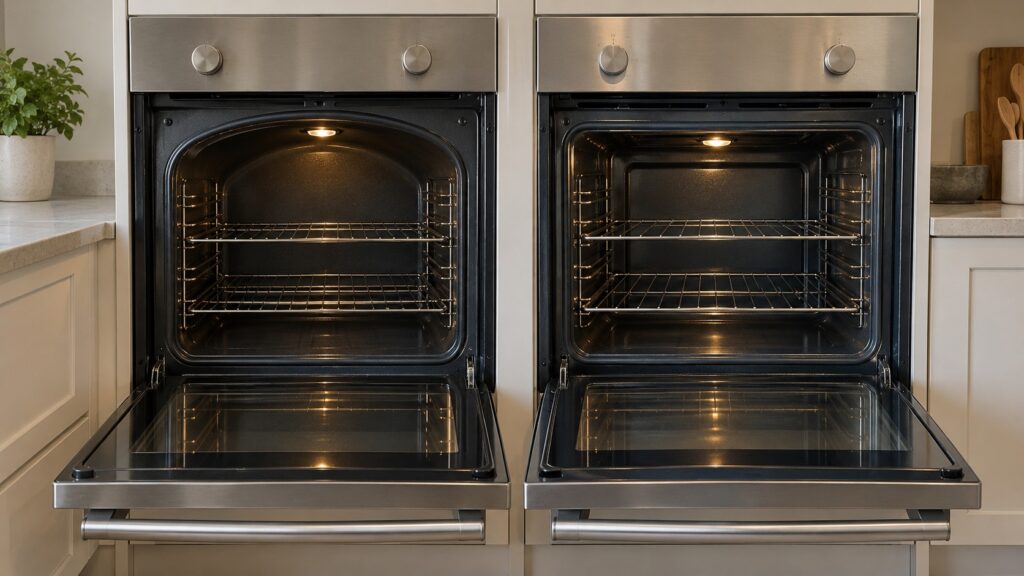
This is the clearest La Cornue distinction. On a Château, the vaulted oven is a sealed dome with no window, shaped as an arched vault rather than a box. Heat radiates from the dome down and around the food, and our vaulted oven guide describes the result as gentle browning without the drying air movement of strong convection. The gas version uses a glow-bar igniter; the electric version offers steady temperatures.
The CornuFé family is different. The CornuFé 90 Albertine has one multifunction convection oven with seven modes and a storage drawer, and the CornuFé 110 has two electric convection ovens. See the seven CornuFé oven modes. For Viking, ask: what oven types and modes does the model offer, how many ovens, and what are the interior dimensions? Compare them with the La Cornue oven you are considering, which matters more than the label on the door.
What about sizes, fuels and the rangetop?
La Cornue lists the Château in six widths from 23.6 to 65 inches, the Grand Palais 180 at 70.9 inches, and the CornuFé at 35.4 and 43 inches. Fuel is gas, dual-fuel or induction depending on the model, and Château rangetops are built from modules such as gas burners, a French Top, a grill, induction, Teppanyaki and a Flamberge rotisserie. On the CornuFé and Grand Palais pages, front burners are listed at about 17,000 BTU and rear burners at about 7,500 BTU on natural gas, and induction zones at 2,100 watts, or 3,700 watts with boost. Our gas versus dual-fuel versus induction guide explains the trade-offs.
Ask the same of any Viking model you are considering: widths, fuel options, burner outputs and whether it offers the module you want. Measure your opening first, and do not rely on rounded sizes; confirm clearances in the installation drawing. Our installation requirements guide lists what to plan for gas, electrical service and ventilation.
How do customization, lead time and warranty differ?
Customization is where the Château is unusual. Our Château versus CornuFé guide says every Château is configured from scratch, with about 50 enamel colors, multiple trim metals and mix-and-match rangetop modules, so lead times are measured in months. The CornuFé offers a curated set of finishes and ships sooner. Our guide says both families carry a five-year parts and labor warranty; confirm the current terms with the maker before you buy, because we do not set them. See the 5-year warranty explained.
For Viking, ask for the delivery time on the exact model and finish, the warranty terms in writing and who services the range in your area. A fast delivery and a long custom lead time are both legitimate trade-offs; the point is to know which one you are accepting.
What should you plan around either range?
Ventilation, gas, electrical service and floor strength apply to any heavy professional range. Plan the hood before installation: it should be at least as wide as the range and matched to the output of your highest-output burners and modules, per our hood sizing guide. Gas connections and induction wiring are jobs for licensed professionals, and a gas smell means leave the home and call from outside. Get the model name and serial number from the rating plate before you call anyone for service.
If you are still weighing La Cornue against other brands, our La Cornue versus Lacanche, Wolf and AGA guide uses the same approach, and is a La Cornue range worth it covers the ownership side.