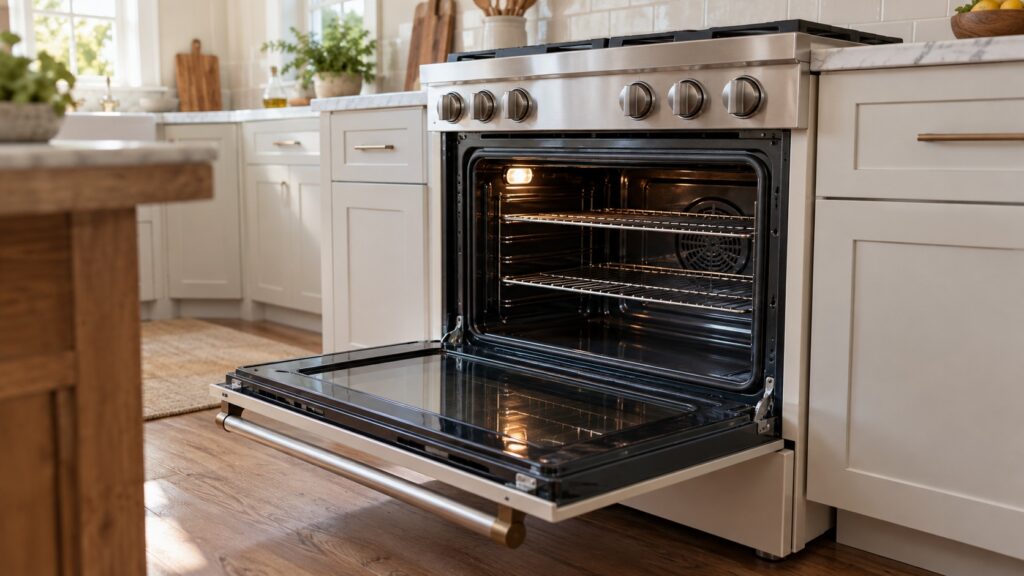
A sagging oven door is the fault that most often makes people wonder whether a La Cornue range has reached the end of its life, and it almost never has. A la cornue oven door hinge is a mechanical part with springs, and springs fatigue. Replacing them restores the door; replacing the range because of them would be one of the more expensive mistakes available in a kitchen.
What the hinge is actually doing
An oven door is heavy, and it has to do two contradictory things: swing down under control rather than falling, and pull itself shut firmly enough to compress a gasket along its whole length. Both come from springs inside the hinge. When those springs weaken, the door does both jobs badly at once — it drops the last few inches instead of gliding, and it no longer pulls closed hard enough to seal.
That is why a single symptom, a door that feels loose, produces a cascade of unrelated-looking complaints: longer cooking times, uneven browning, a kitchen that gets hot while the oven is on, and a control that trips its overheat protection because heat is escaping into the cavity surround.
Telling a hinge problem from a gasket problem
These two produce almost identical symptoms and have different fixes, so it is worth separating them before ordering anything.
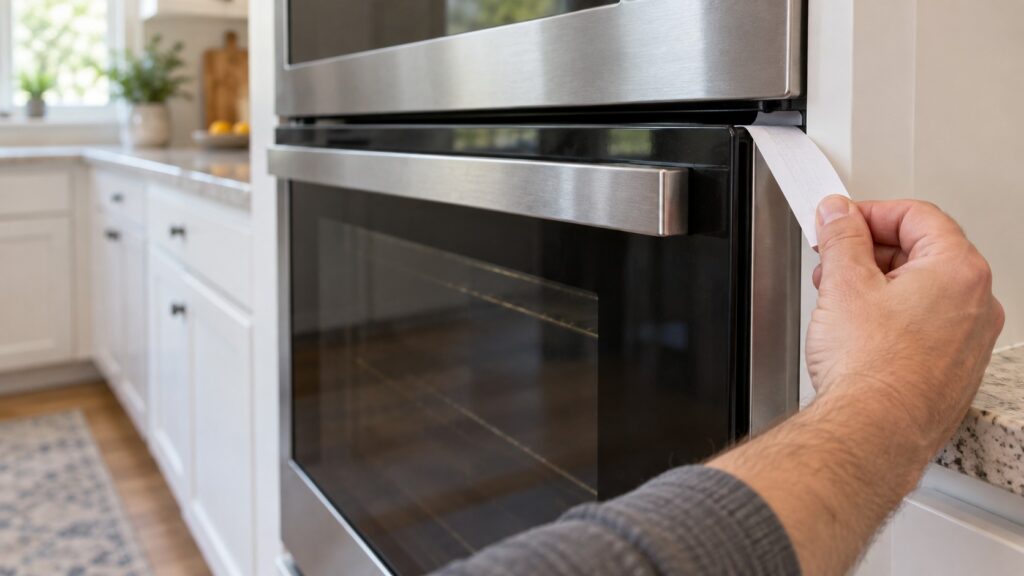
- Paper test. Close the door on a strip of paper and pull. Repeat at several points. If it drags everywhere, the gasket is probably fine and the door is not being pulled in — hinge. If it drags in most places and slips in one, that is a gasket compressed or missing in that spot.
- Look along the gap. A door that is square but standing off evenly is hinge springs. A door that sits lower on one side is a hinge body or a mount.
- Feel the swing. A door that falls rather than glides has lost spring tension, whatever the gasket looks like.
- Check the gasket by hand. Hardened, flattened or torn material is a gasket job — see our gasket care guide.
Our page on an oven door that will not seal works through the same split in more depth.
Why the answer is almost always repair
Hinges are discrete, replaceable parts. They come off with the door, they are not bonded to anything, and on these ranges they are available. The work is mechanical rather than electronic, and nothing about it touches the cavity, the burners or the controls. A range with a new pair of hinges is a range with a new pair of hinges — not a repaired appliance carrying a compromise.
Set against that, the alternative is a range that in every other respect has decades left. La Cornue ranges are built around an enameled steel body and cast components that do not wear out on a domestic duty cycle. Replacing one because of a spring would be a remarkable piece of arithmetic.
Where it does get more complicated
Two situations change the conversation. The first is a hinge mount that has been torn or distorted — usually by someone leaning on an open door, or by a heavy pan dropped onto it. That is a repair to the range body rather than a part swap, and it is worth assessing properly before committing.
The second is a door that is itself damaged: inner glass cracked, or enamel failing along the top edge where the heat is greatest. Those are door problems, not hinge problems, and the answer is usually a door rather than a range. Availability for the specific model decides it, which is a question a technician can answer from the model and serial number.
What not to do while you wait
Do not shim the door, bend the hinge, or pack the gasket with anything. All three are common improvisations and all three make things worse: a shimmed door loads the glass unevenly, a bent hinge will not sit in its mount, and packing material under a gasket compresses at temperature and then holds the door further open than before.
Do not keep using the self-clean cycle, if the range has one, on a door that does not seal — the cycle relies on the seal to contain temperatures far above normal cooking. And do not ignore a door that is dropping fast, because a heavy door falling onto an open hand is a real injury.
How long hinges last, and what shortens it
Springs fatigue with cycles, not with years, so a range in a household that cooks every day reaches this point sooner than one used at weekends. That said, three habits shorten hinge life far more than ordinary use. Leaning on an open door — or letting a child sit on one — applies a load the hinge was never designed for, at the worst possible leverage. Slamming the door drives the springs past their working range on every close. And using the open door as a shelf for a heavy roasting pan does both at once.
None of that means treating the range delicately. It means closing the door with a hand rather than a hip, and putting the pan on the counter. Hinges replaced on a range whose owner does those two things tend not to need replacing again.
Getting an honest number
A diagnosis on this fault is quick, because there are only a few things it can be: springs, hinge bodies, mounts, gasket or door. A technician establishes which from the paper test, the gap and the swing, and the part availability follows from the model and serial number.
We are an independent repair company, not a factory service arm and not a dealer, so we have nothing to sell you on the replacement side. Where a repair is not worth doing, we say so. Pricing starts from a diagnostic visit and we confirm the estimate before any work begins. La Cornue oven repair covers doors, hinges and seals, and you can schedule a visit online. If the oven has also been baking unevenly, our uneven baking guide is worth reading, because a poor seal is one of its causes.