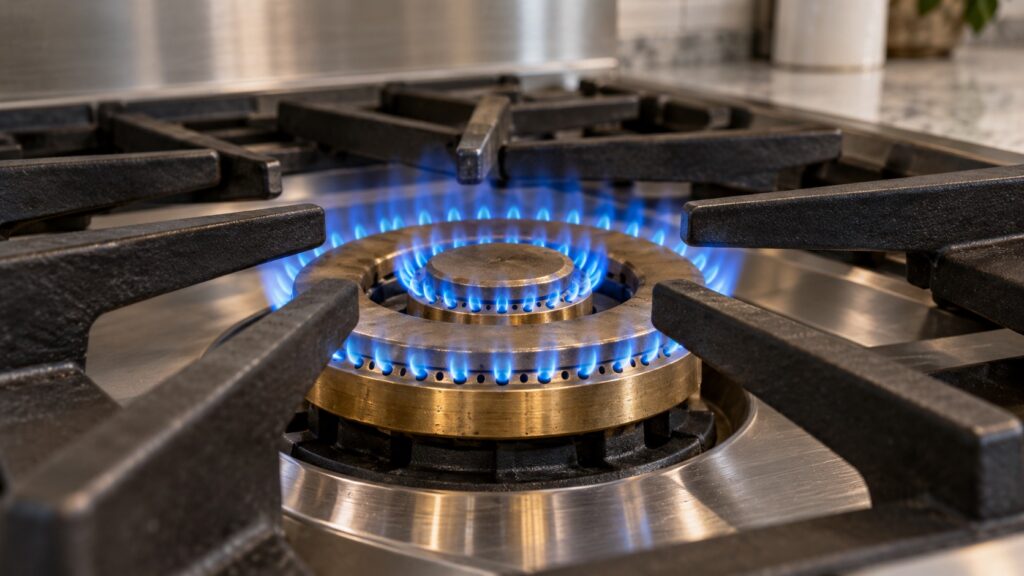
La Cornue burner terms are the handful of words that show up in the owner’s manual, on a spec sheet and in a service call: BTU (how much heat a burner can produce), burner cap and crown (the parts that shape the flame), ports (the small openings the flame comes from), igniter or electrode (the part that sparks), and simmer (the lowest controlled flame). A healthy burner shows a steady blue flame that sits evenly around the crown. This glossary explains each word in everyday language so you can read your documents and describe a problem accurately.
What does BTU mean on a La Cornue burner?
BTU stands for British thermal unit, a unit of heat. On a gas rangetop it tells you how much heat a burner can produce at full power. Our model pages for the Château gas burner rangetop list front burners at about 17,000 BTU and rear burners at about 7,500 BTU on natural gas, with an LP conversion available. Those are the only burner ratings we state here. For any other model, or for a specific burner, use the rating in your owner’s manual or on the model’s spec sheet.
A higher BTU figure does not mean better cooking by itself. It means more range between the strongest and the gentlest settings the burner is built for. It also means the gas line behind the range has to be sized for the total load, which is why our installation requirements guide tells you to confirm the line before delivery day. Gas connections are work for a licensed professional.
What are the burner cap, crown and ports?
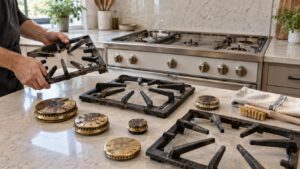
These three words describe the parts that make a flame look the way it does. The crown is the base fixed to the range. The ports are the small openings in it. The cap is the removable piece that sits on top and sends the flame out sideways in a ring. On a La Cornue the caps are brass or enameled metal, and our burner caps and grates care guide explains why a cap must sit flat and centered: a cap resting on a crumb moves the flame away from the spark and the burner clicks without lighting.
When people say flame ring, they usually mean the ring of small flames that comes out of the ports around the crown. A healthy ring is even all the way around. Gaps in the ring tell you a port is blocked by debris or a spill. Clear ports only when the burner is cold and the cap is off, gently, with a wooden toothpick; never a drill bit, a pin or any metal needle, because metal enlarges a port for good. If your cap and crown look damaged rather than dirty, that is a service question rather than a cleaning one.
What does “flammes” mean on the Château rangetop?
Our model page describes the Château gas rangetop as having brass “flammes” gas burners. Flammes is the French word for flames, and La Cornue uses it as a name for the brass burner design on the Château rangetop. We do not have a technical definition beyond that on our site, so if you need to know what sets the design apart on your exact model, check your owner’s manual or ask a technician who has your model in front of them.
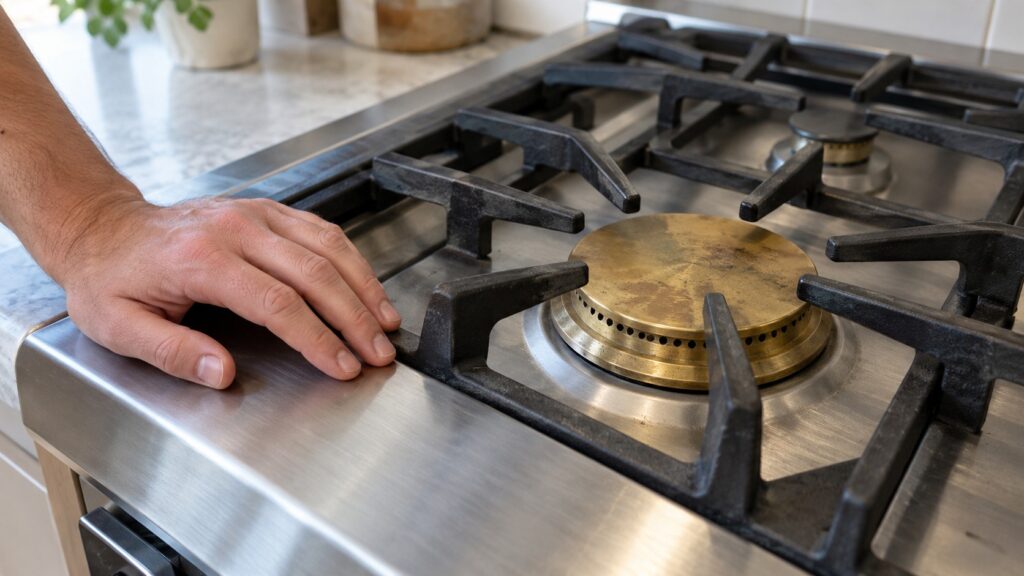
What is an igniter, and why does it click?
The igniter, sometimes called the electrode or spark module, is the part that creates a spark so the gas lights when you turn the knob. The clicking you hear is that spark. A burner that clicks but does not catch is a common complaint, and the cause is often moisture or a misplaced cap rather than a failed part. Our clicking igniter guide and the range won’t light checklist go through the safe checks in order. Do not hold a match to a burner, and do not keep clicking if you smell gas.
If you ever smell gas, do not turn anything on or off and do not light anything. Leave the home and call the gas utility or 911 from outside. Our gas smell safety steps page says the same thing in more detail.
What do simmer, low and high mean on the knob?
Simmer is the lowest flame the burner is designed to hold steadily. High is full output. Between them the flame size changes smoothly as you turn the knob. Where exactly each position sits, and how the knob marks look, differs by model, so we do not describe a knob sequence here; your owner’s manual is the reference. Our simmer and low heat tips explain how to use the low end for sauces. A stiff knob that makes it hard to find the low setting is covered in the stuck burner knob guide.
What should a healthy flame look like?
A healthy gas flame is steady and mostly blue, with small differences in color at the tips. A flame that is yellow, lazy, or flickers on one side is telling you something. Yellow usually points to a combustion or air-mix problem, and a weak flame often means blocked ports. Our yellow flame guide shows what to check, and anything involving gas supply, valves or regulators belongs to a licensed technician.
How do rangetop, cooktop and range differ?
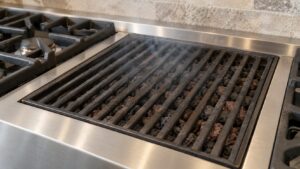
A range is the whole appliance with burners on top and ovens below. A rangetop or cooktop is the surface alone, set into a counter or fitted as a module within a larger range. On a Château, the burners, the French top, the grill module and the teppanyaki plate are modules that fit the rangetop bays. Our guide to decoding La Cornue model names helps you read the name on your paperwork. We do not explain what the letters in a model name stand for unless a page of this site says so.