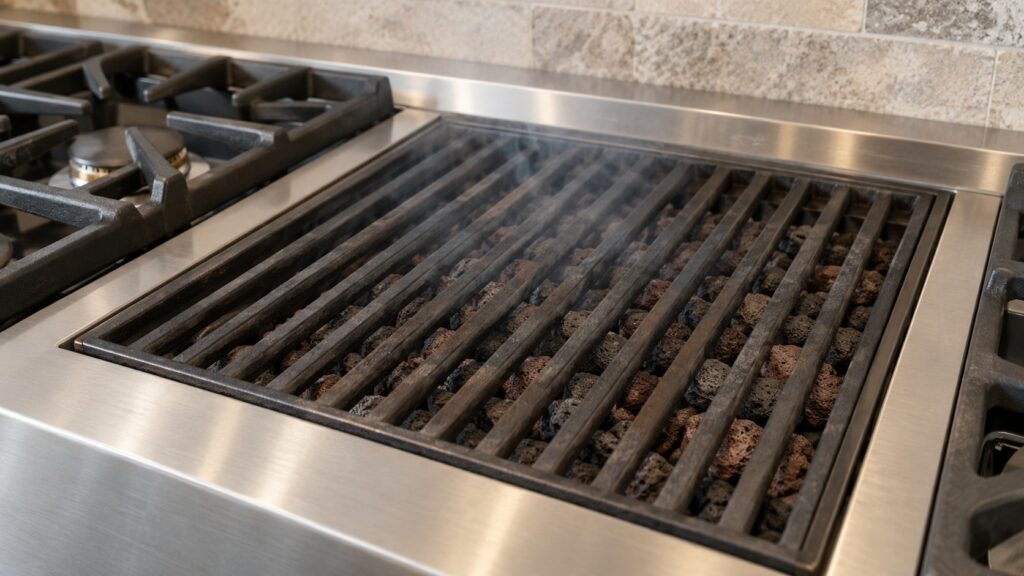
How a La Cornue grill module works is simple to state: it uses a gas burner to heat a bed of lava rock, and the hot rocks then radiate even heat up to the grate. Food sears on contact, and drippings that fall on the hot rocks vaporize and rise back as smoke and flavor. That is the same principle as an outdoor gas grill, built into a Château rangetop bay. Our model page describes the Château grill module as a lava-rock gas grill cooking module, heated by a dedicated gas grill burner over lava rock, with a mechanical or electronic control depending on the module.
How does a lava rock grill heat food?
The burner sits below the rock bed and heats it. The rocks are porous and hold heat well, so instead of a few hot flame points you get a broad, even source of radiant heat under the grate. That is why the grate sears the whole surface of a steak rather than leaving stripes of hot and cold. Because the rocks store and spread heat, the grate heats evenly, which suits searing. How long the rocks need to come up to heat depends on the module, so follow your owner’s manual rather than a number from us.
The module is one of several that can fill the rangetop bays of a Château. The French top, the gas burners and the electric teppanyaki plate cook very differently, and our rangetop configuration guide explains how people choose between them.
What happens to drippings and why do flare-ups happen?
Drippings that land on the hot rocks vaporize, and that smoke carries the grilled flavor back up into the food. The same mechanism causes flare-ups: when too much fat lands on the rocks, it ignites briefly. Grease built up in the rocks over many sessions makes it worse. Our lava rock grill tips suggest trimming excess fat, not overloading the grate and oiling the food rather than the rocks. If a flare-up starts, move the food to a cooler part of the grate.
If grease ever catches fire in a pan or on the grate and does not die down, cover it with a lid if you can do so safely, turn the burner off, and do not pour water on it. Do not turn the hood on, because the airflow can feed a fire. Call 911 if it is not under control.
What are the main parts of the module?
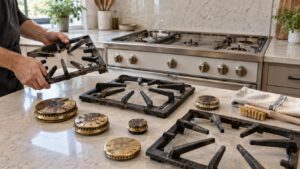
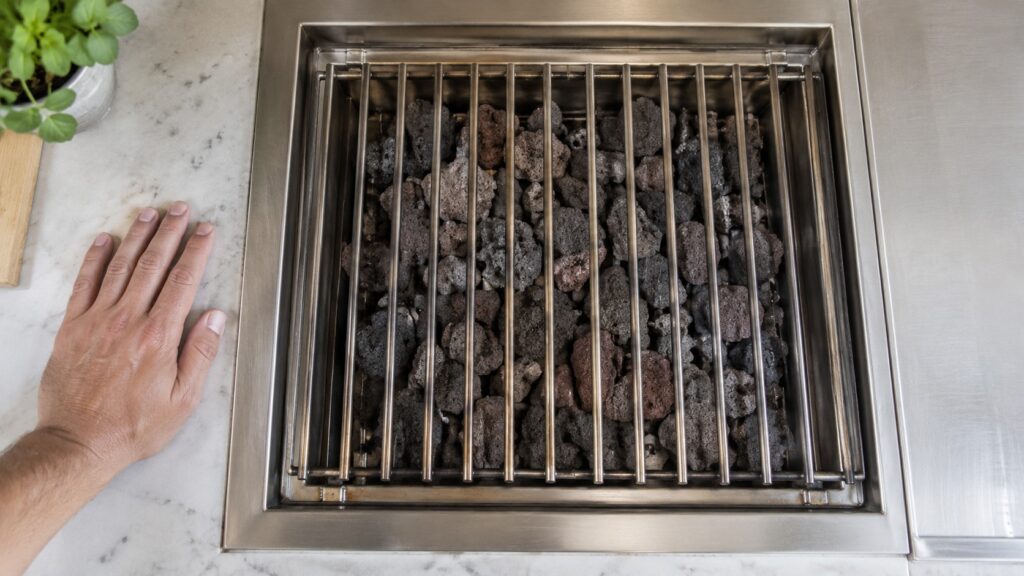
There are four parts you will deal with as an owner. The grate is the cooking surface, usually removable so you can reach the rocks. The lava rocks are the heat bed. The drip tray catches grease. Underneath, the burner and its igniter produce the flame. The grate, the rocks and the tray are routine care items. The burner, the valve and the igniter are gas components, and anything beyond wiping and cleaning a cold, cooled module belongs to a technician. Our grill module and lava rock care guide walks through upkeep.
How do you keep a grill module working well?
The routine is short. Let the grill cool, brush the grate, wipe the surrounding area and empty the drip tray after use. Your owner’s manual says whether and how grease should be burned off the rocks; do not run the burner with the grate removed unless it tells you to. Once the module is cold, you can turn the rocks so the greasy side faces down. Replace rocks that crumble or stay greasy and smoky after a burn-off, and lay the new ones in an even layer so heat reaches the grate uniformly. Do not soak the rocks. Grilling puts grease-laden smoke into the air, so use your hood while you cook; our hood sizing guide explains why the hood should match your highest-output modules.
What does it mean when the grill will not light or burns unevenly?
A grill burner that clicks without lighting, or burns unevenly, usually has fouled ports or a dirty igniter, much like any other burner. Our grill clogged page describes the pattern and the range won’t light checklist lists the safe checks, such as drying parts and making sure everything is seated. If there is any smell of gas, do not light anything or flip any switch; leave the home and call the gas utility or 911 from outside. Valves and gas lines are never an owner repair.
How is it different from a gas burner or a teppanyaki plate?
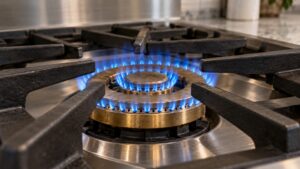
A burner heats a pan from below with a small ring of flame, so the pan does the cooking. A grill module heats the food directly through the grate, with radiant heat from the rock bed, and it adds smoke from the drippings. The teppanyaki plate is electric and flat, so it has no lava rocks to catch drippings; our teppanyaki cooking tips cover it. Pick the grill when you want char and grilled flavor, and the plate for small pieces such as diced vegetables.
What does your exact module do, and where do you check?
Controls differ by module: our model page says mechanical knob or electronic, depending on the module. The knob positions, any safety features and how the grate comes out are all in your owner’s manual. We describe the principle here, not a button sequence. If you are choosing a rangetop, our care page and the model page for the Château grill module are the two places to start.