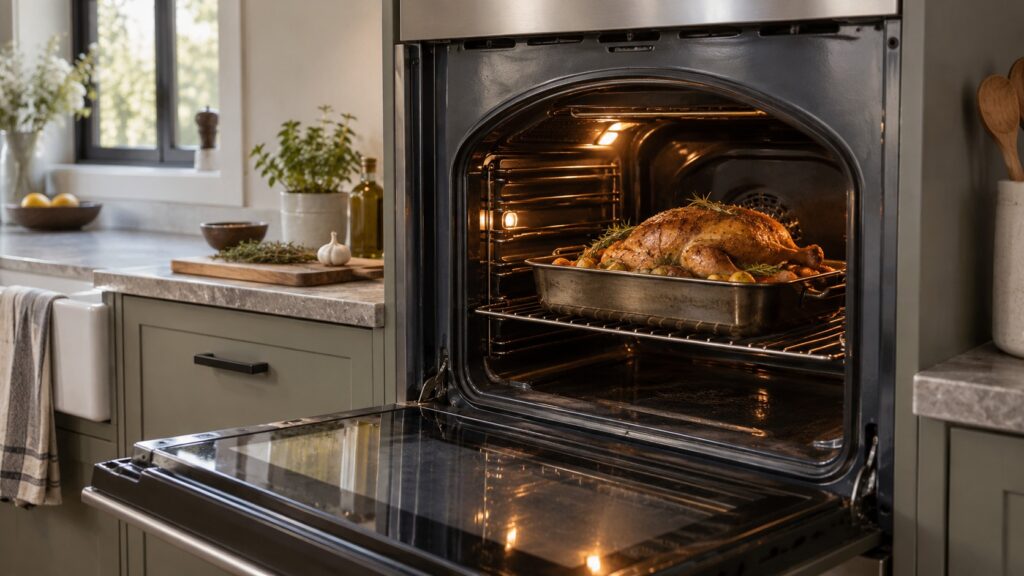
La Cornue oven terms are easier to follow once you know that most of them name a part of the same loop: a flame or element makes heat, a thermostat and a safety valve control it, a vaulted ceiling and a door gasket keep it, and a hi-limit protects the cavity from running away. This glossary defines each term the way it appears in owner manuals and service notes for the vaulted ovens in the Château and CornuFé ranges.
What is a vaulted oven?
A vaulted oven has an arched ceiling instead of a flat one. The arch reflects radiant heat from the top of the cavity back down toward the food and spreads it more evenly across the whole cooking surface, and it helps hold moisture in roasts and bakes. It is the signature of the brand’s ovens and the reason the cooking feels different from a boxy cavity. Our guide to how the La Cornue vaulted oven works explains the design, and the owner’s manual for your model lists the capacity and the heating modes it offers.
What do igniter, safety valve and pilot mean?
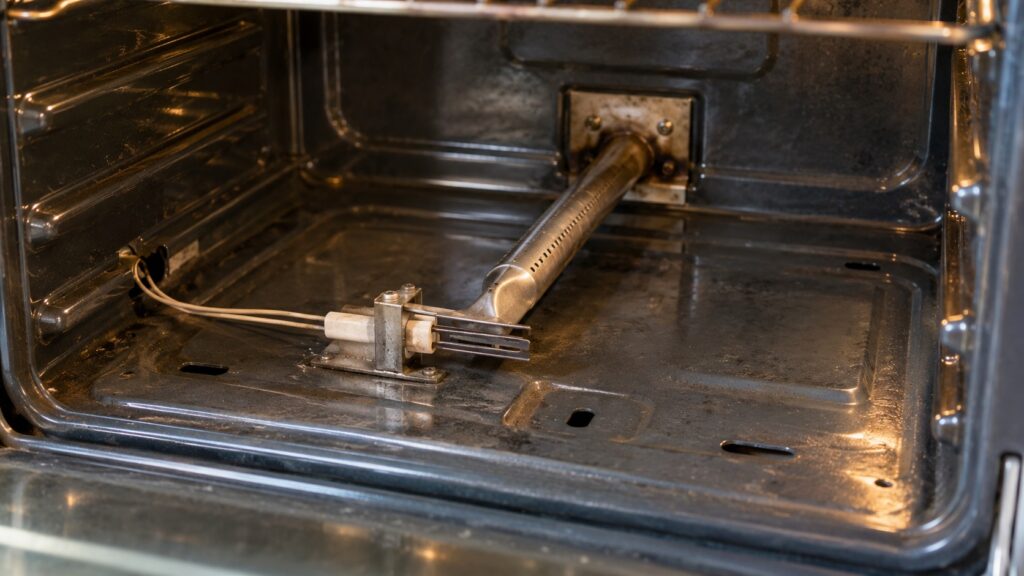
A gas oven lights its burner with an igniter. Many ovens use a glow-bar igniter that heats until it is hot enough to light the gas, and a safety valve that opens only once the igniter draws enough current to prove it is hot. Some older or simpler designs use a standing pilot flame, a small flame that stays lit and lights the burner when called. The safety valve is the important part: it is built to close the gas if the flame goes out, so gas does not keep flowing into the oven. A weak igniter that glows but does not hold the valve open is a common cause of an oven that clicks, glows and then fails to light. If you smell gas at any time, leave the area and follow the steps in our gas smell safety guide.
What is the hi-limit?
The hi-limit is a safety thermostat set well above any normal cooking temperature. If the oven overheats because a thermostat fails or a control misbehaves, the hi-limit cuts the heat before the cavity gets dangerous. When it trips, the oven stops heating and may need a reset or a service visit. It protects you and the oven, and it is not a fault in itself. If you are unsure why it tripped, our guide on hi-limit trip and reset explains what to check.
What are catalytic panels and what do they do?
Some La Cornue ovens have catalytic panels, coated liners on the walls of the cavity that help oxidize grease and splatter when the oven is hot. They are not a self-cleaning cycle, and they do not remove every stain. Over time the coating wears, and the panels lose their effect. Our catalytic panel maintenance guide explains how to care for them and when to replace them. Never scrub a catalytic panel with an abrasive pad, since you will remove the coating you want.
What do convection, bake and the other modes mean?
Modes are the combinations of heat sources and fans that the oven can use. Traditional bake uses heat from the bottom burner or element and the vaulted ceiling radiates it back. Convection adds a fan to circulate hot air, which cooks faster and more evenly and suits roasting and multi-rack baking. Some ovens add grill or broil modes that use a heat source at the top. The number and names of modes vary by model. Our guide to the CornuFé multifunction oven modes explains the choices on that range. The same logic applies to a gas oven: a different burner, element or fan combination yields a different style of heat.
What other terms help when reading a manual?
- Preheat: bringing the cavity to the set temperature before cooking begins.
- Thermostat: the part that senses temperature and tells the burner when to cycle.
- Calibration: adjusting the oven so the set temperature matches the real one.
- Door gasket: the seal around the door that keeps heat in, explained in our door gasket care guide.
- Heat loss: heat escaping through a worn seal or a door that does not close fully.
If a term in your manual is not on this list, our general La Cornue glossary covers more of the brand’s vocabulary. When a fault is involved, our oven repair page explains how a visit works.
Which terms describe how a La Cornue is built?
Several words in the brand’s literature describe construction rather than function. Vitreous enamel is a glass-like coating fired onto the steel body, which gives the deep color and resists staining when cared for properly. A French top is a solid cooking plate heated from below, and a rangetop is a cooking surface without an oven beneath it. Trim refers to the metal knobs, rails and handles, available in finishes such as brushed nickel, polished brass and chrome. A module is a self-contained cooking unit, such as a grill or a griddle, that can be added to a larger range. Knowing which word belongs to which part makes it far easier to read a quote, a manual or a parts list, and to describe a problem to a technician in a way that gets the right part to the first visit.