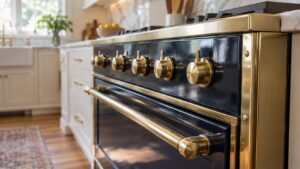
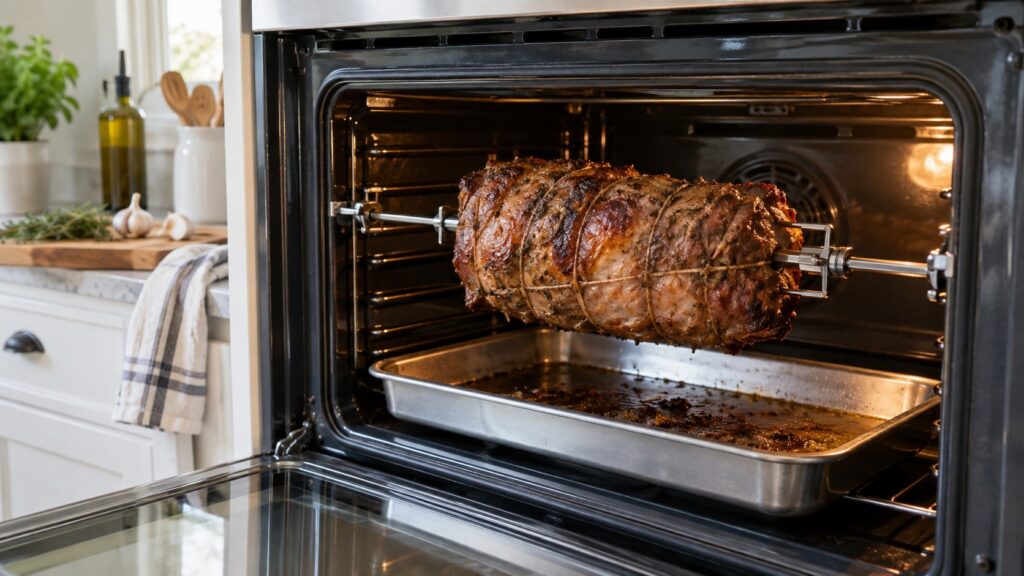
The La Cornue flamberge is the rotisserie: a motor-driven spit that turns a joint in front of, or beneath, a heat source so it self-bastes as it cooks. On a range where nearly everything else has a modern equivalent, the flamberge is the part that is genuinely old-fashioned in the useful sense — a mechanism that does one thing extremely well and has not needed improving.
Why turning changes the result
A joint cooked stationary renders its fat downward. It collects under the meat, the underside sits in it, and the top dries while the bottom steams. A joint that turns continuously brings each surface past the heat and back through its own rendering fat, which is what self-basting actually means. The result is an even crust and a joint that needs no attention while it cooks.
That is the whole mechanism. There is no clever electronics and nothing to configure — which is also why a flamberge that is set up correctly is one of the most reliable things on the range.
Balance is the requirement
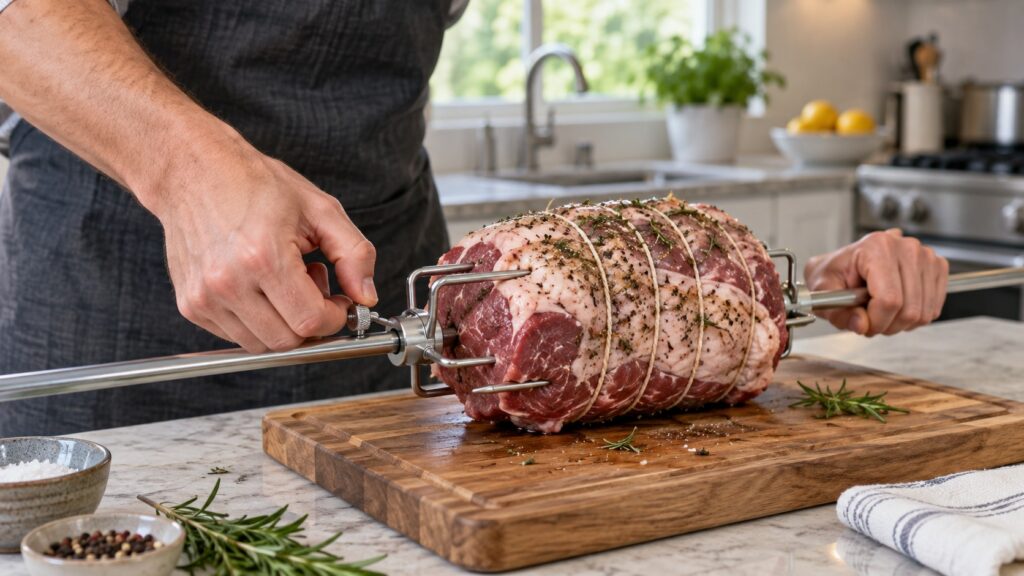
Almost every flamberge complaint traces back to load rather than to hardware. A spit carries the joint through its center of mass; get that wrong and the motor is lifting a weight on every revolution instead of rotating a balanced one. It labors, it may stall at the same point each turn, and over time that is what wears a drive out.
- Center the joint on the spit before tightening the forks, not after.
- Truss it. Loose wings, legs or a flap of belly swing out, unbalance the load and catch on the cavity.
- Tighten both forks firmly and check by spinning the spit by hand — it should not flop to one position.
- Respect the weight limit for the model. A spit is not the place to find out where the limit is.
Seating, and the fault that looks like a dead motor
The spit has to sit properly in its socket and engage the drive. A spit that is not fully home turns for a while, then slips, and the symptom is a rotisserie that stops without anything having failed. People usually conclude the motor has gone.
Before assuming that, take the spit out, check the socket is clear of cooked-on residue, and refit it deliberately until it seats. Then test empty. A spit that turns cleanly with no load and stalls with one is a balance or a weight problem; a spit that will not turn empty either is the drive. Our page on a flamberge that will not turn works through that split in detail.
The drip tray is not optional
A rotisserie throws rendered fat in a wide arc. A tray beneath catches it; without one, it goes onto the cavity floor and the walls, bakes on at roasting temperature, and becomes the kind of deposit that no ordinary cleaning removes. On an enameled cavity that matters more than on a stainless one, because abrasives are not an option — see our catalytic panel guide for what the cavity liners can and cannot handle.
A little water in the tray keeps the drippings from burning and gives you the basis of a gravy. It also makes the tray far easier to wash.
Using it well
Preheat before loading, so the surface of the joint sets quickly rather than sweating. Start at a higher heat to develop color and drop it to finish, rather than cooking the whole time at one setting. Leave the door arrangement as the model intends — a rotisserie run with the door in the wrong position either loses its heat or overheats the drive above it.
And cook to temperature rather than to time. A turning joint browns faster than a stationary one, so the color is ready before the center is; a probe thermometer settles it.
What suits a spit, and what does not
The mechanism rewards a particular shape. A compact, roughly cylindrical joint that can be trussed into an even barrel turns well and cooks evenly: a chicken, a boned and rolled shoulder, a rib of beef tied short, a leg of lamb with the shank folded in. Anything long, floppy or lopsided fights the spit — a whole fish, a flat cut, or a bird left untrussed with the legs splayed.
Fat matters as much as shape. A joint with a fat cap on one side self-bastes beautifully; a very lean cut has nothing to render and dries whatever you do, so it wants barding or a jacket of bacon rather than a rotisserie on its own. And avoid anything in a sticky glaze from the start: sugar applied early burns onto the spit and the cavity long before the center is cooked. Glaze in the last few minutes.
Cleaning the spit and forks
The spit and forks come off and should be washed after every use, while the residue is still soft. Once baked on, the join between fork and spit is the hardest part to clear, and a fork that cannot be tightened properly next time is exactly how the balance problems earlier in this guide begin.
Keep abrasives away from anything that runs in the socket. A scratched spit picks up residue faster each time, and a burr on the drive end will chew the coupling it seats into.
What goes wrong, and what is worth fixing
The parts are few and nearly all of them are replaceable: the motor, the drive coupling, the socket, the spit and the forks. A motor that hums without turning is usually a coupling or an obstruction; a motor that is silent is the motor or its supply. None of it is structural and none of it is a reason to think differently about the range.
We are an independent repair company, not a factory service arm. Pricing starts from a diagnostic visit and we confirm the estimate before any work begins. La Cornue range repair covers the rotisserie drive along with the rest of the cooking systems, and you can schedule a visit online. For the vocabulary around the rest of the range, our La Cornue glossary is the place to start.