Repair or Replace a La Cornue Induction
Repair or Replace a La Cornue Induction is a common question among La Cornue owners. This guide walks through it step by step with technician-grade detail.
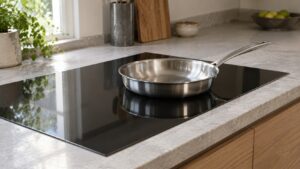
La Cornue induction cooktops and rangetop modules are reliable, but glass can crack and electronics can problem. The repair-or-replace decision depends on which part has failed. This guide walks through it.
Cracked induction glass
A cracked ceramic-glass surface should not be used — moisture can reach the electronics and the crack can spread. The glass is replaceable as a part, so a crack is a repair, not a reason to replace the whole range. Replacing the glass restores the module.
A single dead zone
If one zone shows a flashing “U” while a known-compatible magnetic pan sits on it — and other zones work — the induction coil or its sensor for that zone has likely failed. That is a component-level repair, not a full replacement. See our induction “U” flashing guide.
E2 and U400 problems
An E2 code means the electronics overheated or a pan boiled dry — often resolved by improving ventilation and letting the unit cool. A U400 code indicates the cooker is incorrectly connected (a wiring failure), corrected by fixing the installation wiring. Neither is a reason to replace the module. See our E2 overheating guide and U400 connection error guide.
When replacement of the module makes sense
If the main induction control board fails and the part is unavailable, or if multiple coils and the board have all failed, replacing the induction module may be more economical than piecemeal repairs. Even then, you are replacing a module — not the entire range.
Cost framing
Glass and single-coil repairs are modest, starting from a low parts-and-labor figure; full board or module replacement costs more but still far less than a new range. For details, see our induction coil replacement guide and the overall repair cost guide.
Service
Induction repairs involve high-voltage electronics and precise diagnostics. Our technicians test coils, sensors, and boards to pinpoint the problem. View specifications on lacornueusa.com, and schedule a diagnostic to get an accurate repair-or-replace recommendation.
Match the problem to the right fix
Induction problems sort cleanly into repairs once you identify the symptom. A flashing “U” with a known-good pan on one zone (while others work) points to that zone’s coil or sensor — a component swap. An E2 is an overheat, usually cleared by cooling the unit and improving ventilation, not a parts failure. A U400 is a wiring failure corrected at the connection, never the cookware. Only a failed main control board with no available part pushes toward module replacement — and even then you replace a module, not the range. Our coil replacement guide covers the most common hardware repair.
Don’t keep using cracked glass
A cracked ceramic surface is the one situation where you must stop immediately: moisture can reach the live electronics beneath, and cracks spread under heat. The glass is a replaceable part, so this is a repair — but it is not safe to defer. Keep the surface scratch-free in the first place with our induction glass cleaning guide.
Frequently asked
- Why are induction repairs technician-only? The electronics carry high voltage and capacitors that hold a charge even unplugged.
- Is a single dead zone worth fixing? Almost always — a one-zone coil or sensor repair is far cheaper than any module replacement.
When module replacement is the economical call
Replacement of the induction module (never the whole range) only makes sense in narrow cases: a main control board failure where the part is unavailable, or multiple coils plus the board all failing at once, where piecemeal repairs would exceed the cost of a new module. Even then you are swapping a module, not the range. For the common problems — glass cracks, single dead zones, E2, U400 — component-level repair wins decisively. A diagnostic gives you an accurate “from $X” repair-or-replace recommendation; see our repair cost guide.