How La Cornue Induction Cooking Works
How La Cornue Induction Cooking Works is a common question among La Cornue owners. This guide walks through it step by step with technician-grade detail.
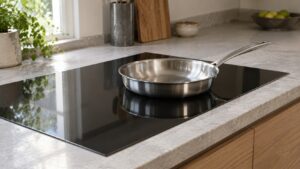
Induction is the most modern cooking option La Cornue offers, available on Château induction rangetops and the CornuFé 90 and 110. Instead of a flame or a glowing element, it heats the pan directly with magnetism. This guide explains how it works.
The principle: heat the pan, not the surface
Beneath each induction zone is a coil of wire. When you turn the zone on, alternating current flows through the coil and creates a rapidly changing magnetic field. When a ferrous (magnetic) pan sits on the zone, that field induces electric currents in the pan’s base, and the pan’s own resistance turns those currents into heat. The glass surface stays relatively cool — it is the pan that heats.
Why it is so responsive
Because the heat is generated in the pan itself, induction responds almost instantly to control changes — comparable to or faster than gas. La Cornue induction zones run around 2,100W, with a boost up to about 3,700W for fast boiling. Turn it down and the heat drops immediately.
Pan detection
Induction only works with magnetic cookware placed correctly over the coil. The cooktop detects whether a suitable pan is present; if not, the zone shows a flashing “U” and won’t heat — normal protective behavior. For what to use, see our induction cookware guide, and for the “U” indicator, our “U” flashing guide.
Residual-heat indicator
Even though the glass doesn’t generate heat, it gets warm from the hot pan. An “H” residual-heat indicator warns you that a zone is still hot after cooking, so you don’t touch it. This is a safety feature, not a problem.
Safety and efficiency
Induction is efficient because little heat is wasted into the air, and it is safer because the surface cools quickly and won’t heat without a proper pan. Overheat protection (the E2 function) shuts a zone down if a pan boils dry.
Installation note
Induction needs correct high-amperage wiring; miswiring causes the U400 problem. See our wiring guide.
Learn more
Specifications are on lacornueusa.com. For service on an induction module, schedule a technician.
Why the glass stays cooler
The detail that surprises new induction users is that the cooktop surface itself is not the heat source — the pan is. The coil’s magnetic field induces currents directly in a ferrous pan’s base, and the pan’s own resistance generates the heat. The glass only gets warm by contact with the hot pan, which is why areas without a pan stay relatively cool and why the surface cools quickly after you lift the cookware. This is the basis of induction’s efficiency and its safety advantage.
Reading the indicators
Two indicators reflect how the technology behaves. A flashing “U” means the cooktop senses no suitable pan — missing, too small, off-center, or non-magnetic — and is normal protective behavior (see our “U” flashing guide). An “H” is the residual-heat indicator warning that a zone is still hot from the pan even though the glass generates no heat of its own. Neither is a problem; both are the system communicating its state.
Frequently asked
- Why so responsive? Heat is generated in the pan itself, so it rises and falls almost instantly with the control — comparable to or faster than gas.
- What about wiring? Induction needs correct high-amperage wiring; a mismatch causes U400 — see our wiring guide.
Why induction is efficient and safe
Because the heat is generated in the pan rather than the surface, little energy is wasted warming the air or the glass, making induction highly efficient. It is also safer: the surface cools quickly after you lift the pan, and a zone won’t heat without a proper magnetic pan in place. Built-in overheat protection — the E2 function — shuts a zone down if a pot boils dry, and the residual-heat “H” indicator warns you a zone is still hot. La Cornue offers induction on Château rangetops and the CornuFé 90 and 110, with zones around 2,100W and a boost to about 3,700W.